Web design proposal template
A web design proposal template is a ready outline for pitching a website project: goals, discovery and sitemap, design rounds, who supplies content, build and launch, deliverables, timeline, price, training, a hosting and care plan, terms and sign-off. Read the full template below, or fill in the form to get a finished proposal you can edit and download free.
By The Clinchdraft team (Product and testing). Last updated .
How to fill in a web design proposal template, step by step
- Write what the site must achieve as a goal, such as turn more visitors into booked appointments.
- List the deliverables in the order the client will see them: sitemap, designs, build, launch and training.
- Decide how many design rounds you include and who writes the copy, then fill in those brackets.
- Enter up to three price options, for example a theme based site, a custom site and a custom site with a care plan.
- Then press Generate, read the draft and edit any section in place.
- Finally, download the Word file and send it with two or three links to sites you have built.
Generating a proposal is free and needs no account. Tailoring it to a client brief uses a credit, so see the pricing page for packs and plans, or read how we test the templates.
Web design proposal template tested with a real input
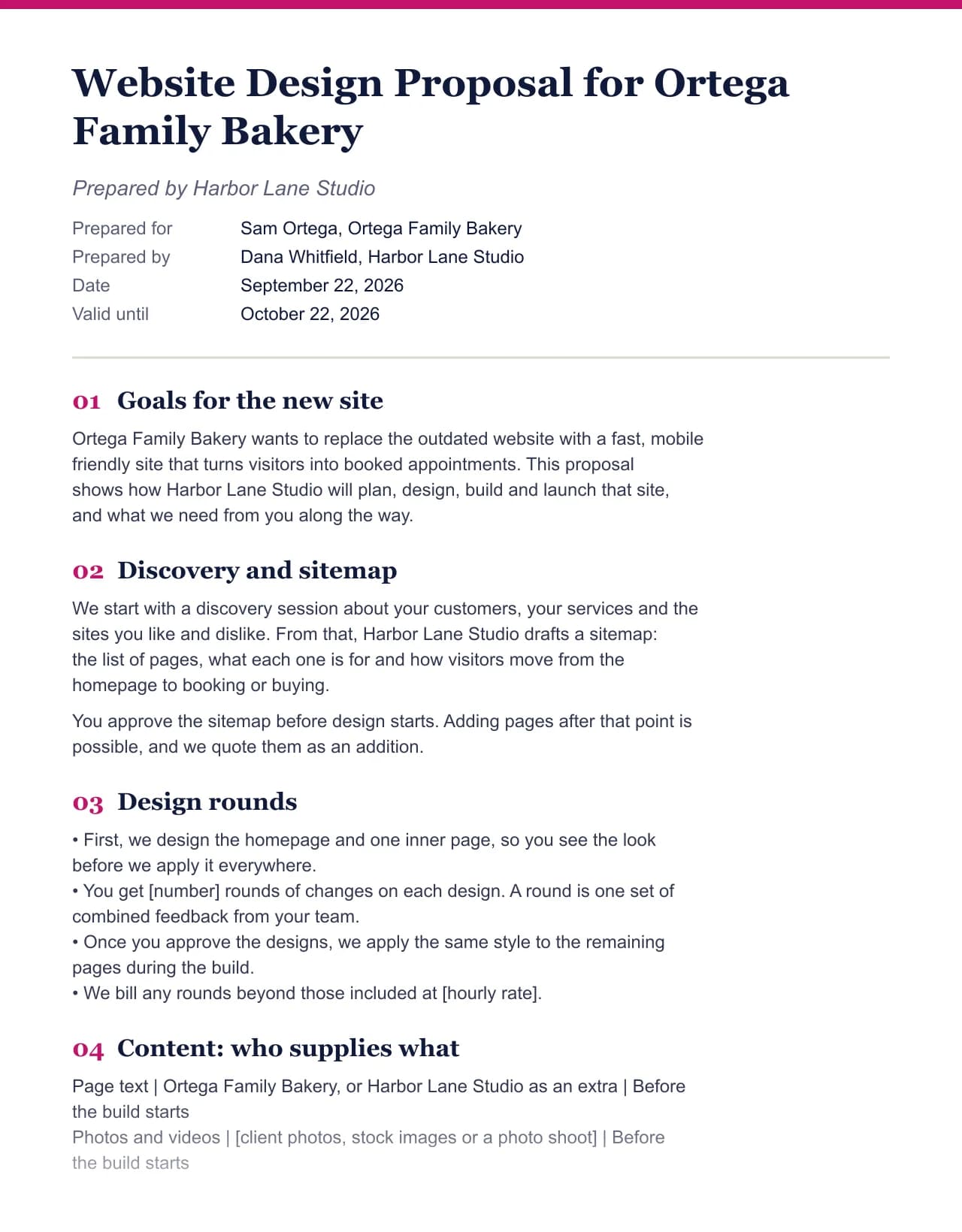
We ran a fictional business and client through this exact generator. Every number below comes from that run, including the size of the Word file the download button produces.
- Test input
- Harbor Lane Studio (fictional) writing to Ortega Family Bakery, with the default deliverables and prices for this field
- Output
- Website Design Proposal, 12 sections
- Words
- 770
- Sections
- 12
- Price options
- 3
- Placeholders left
- 5
- Word file size
- 12 KB
- Generation time
- 1 ms
How we test: every page uses the same input, and we check each output by hand. More on the about page.
The full web design proposal template, section by section
This is the exact text the generator starts from. It fits a small business site of five to ten pages, so add sections on product catalogs and payments for an online store.
Text in square brackets is yours to fill in. The tool above fills it for you, and the notes explain why each section is there.
Website Design Proposal for [Client company]
- Prepared for
- [Client name], [Client company]
- Prepared by
- [Your name], [Your business]
- Date
- [date]
- Valid until
- [date]
01Goals for the new site
Why this section: A website is a business tool, not a brochure. Opening with what the site must achieve gives every later choice, from the sitemap to the design, a reason the client can agree with.
[Client company] wants to [reach the client's goal]. This proposal shows how [Your business] will plan, design, build and launch that site, and what we need from you along the way.
02Discovery and sitemap
Why this section: Most website redesigns fail because nobody agreed on what pages the site needs and what each one is for. A discovery step and an approved sitemap stop the project from growing page by page.
We start with a discovery session about your customers, your services and the sites you like and dislike. From that, [Your business] drafts a sitemap: the list of pages, what each one is for and how visitors move from the homepage to booking or buying.
You approve the sitemap before design starts. Adding pages after that point is possible, and we quote them as an addition.
03Design rounds
Why this section: Unlimited revisions are the fastest way to lose money on a web project. Saying how many rounds are included, and what a round is, lets the client give focused feedback and keeps the schedule intact.
- First, we design the homepage and one inner page, so you see the look before we apply it everywhere.
- You get [number] rounds of changes on each design. A round is one set of combined feedback from your team.
- Once you approve the designs, we apply the same style to the remaining pages during the build.
- We bill any rounds beyond those included at [hourly rate].
04Content: who supplies what
Why this section: Missing copy and photos delay more website launches than design or code. Stating who writes the text, who supplies the images and when they are due protects the launch date for both sides.
| Content | Who provides it | When |
|---|---|---|
| Page text | [Client company], or [Your business] as an extra | Before the build starts |
| Photos and videos | [client photos, stock images or a photo shoot] | Before the build starts |
| Logo and brand colors | [Client company] | At kickoff |
| Service details, prices and FAQs | [Client company] | Before the build starts |
If content arrives late, the launch date moves by the same number of days. We can write copy or source stock photos as an extra if that helps.
05Build and launch
Why this section: Clients rarely know what happens between approved designs and a live site. Explaining the build, the testing and the launch steps, including redirects from old pages, shows the care that protects their search traffic.
- Build: we develop the site on [platform] on a private staging address where you can follow progress.
- Testing: we check every page on phones, tablets and desktop browsers, test all forms and check load speed.
- Launch: we move the site to your domain, set up redirects from old page addresses and submit the sitemap to search engines.
- Access: [Client company] owns the domain, the hosting account and the site, and receives all logins at launch.
06What you get
Why this section: A numbered list of what the client gets is the part they read twice. A clear list also protects you: anything not on it is extra work with an extra price.
[Your business] will deliver the following for [Client company]:
- Discovery call and a sitemap of up to eight pages
- Custom homepage design and one inner page design, with two rounds of changes
- Responsive build on WordPress with an online booking form
- Basic on-page SEO setup and connection to Google Analytics
- Launch, redirects from old pages and a one hour training session
Anything not on this list is outside the scope of this proposal. If the project needs more, we will agree on it in writing before any extra work starts.
07Timeline
Why this section: Clients plan around your dates. So state the length, say when the clock starts and say what happens when feedback is late.
The work takes [timeline, for example 6 weeks] from the day this proposal is accepted and the first payment arrives.
The schedule assumes feedback within two business days at each review point. If materials or approvals arrive later, the dates move by the same number of days.
08Price
Why this section: Show the price in a table next to what it buys. Two or three options let the client choose a level instead of saying yes or no to a single number.
There are 3 options below, so [Client company] can choose the level that fits the budget and the goal.
| Option | What is included | Price |
|---|---|---|
| Starter site | Up to five pages from a customized theme | [price] |
| Custom site | Up to eight custom designed pages with online booking | [price] |
| Custom site and care plan | Custom site plus the first year of hosting, updates and small edits | [price] |
Payment terms: [payment terms, for example 50% to start and 50% on delivery].
All prices are in USD.
09Training
Why this section: A site the client cannot update goes stale within months. A short training session and written notes let their team change text, add posts and swap photos without calling the designer.
After launch, [Your business] runs a training session for your team on updating pages, adding posts and replacing images. We record it, and you also get short written notes to keep.
10Hosting and care plan
Why this section: Websites need updates, backups and security fixes after launch. Offering a care plan, and saying clearly what it covers, keeps the site safe and makes the ongoing cost visible before the client signs.
After launch, [Client company] can look after the site in house or choose our optional care plan at [monthly fee]. The care plan includes:
- Hosting on a managed server, or management of your existing hosting account.
- Software and plugin updates, daily backups and uptime monitoring.
- Up to [number] small content edits per month.
11Terms
Why this section: Web projects touch licenses, logins and ownership. Clear terms on who owns the design, how third party licenses work and how extra pages are handled prevent disputes after launch.
- Payment: [payment terms, for example 50% to start and 50% on delivery]. We launch the site once the final payment has cleared.
- Ownership: once paid in full, [Client company] owns the final design and site files. Themes, plugins, fonts and stock images stay under their own licenses.
- Changes: we quote pages or features outside the scope separately and start them after written approval.
- Portfolio: [Your business] may show the finished site in its portfolio unless you ask us not to.
12Next steps
Why this section: End with one clear action and a signature block. An expiry date gives the client a reason to decide and protects you from old prices.
To go ahead, sign below and reply to this proposal. We then send the first invoice and book the kickoff call.
This proposal is valid until [date] (30 days).
| [Your business] | [Client company] | |
|---|---|---|
| Name | [Your name] | [Client name] |
| Signature | ||
| Date |
What goes into a web design proposal template
A website client can see your portfolio, so they rarely doubt that you can design. What they doubt is the process: how many changes they get, when the site goes live and what happens after launch. A strong proposal answers those questions before the call ends.
That is why this web design proposal template walks through the project in order. First discovery and a sitemap the client approves, then design rounds with a set number of changes, then the build, testing and launch. Each step has a clear handoff, so the client always knows what they are waiting for and what you are waiting for.
The content table is the section that saves the most time. In many projects the design is done weeks before the client sends page text and photos. Naming who supplies each piece, and when, turns a vague delay into a date both sides agreed to.
How to price a web design project
Most small studios price websites per project rather than per hour, because clients want to know the total before they commit. The main cost drivers are the number of unique page designs, custom features such as booking or e-commerce, and whether you write the copy.
Our web design proposal template offers up to three options. For example, a site built from a customized theme, a custom designed site, and the custom site bundled with a year of care. The bundle often suits clients who do not want to think about updates and backups.
Keep the build fee and the care plan apart in the text, even when you bundle them. That way the client sees the monthly cost of looking after the site, and you avoid doing free maintenance for years because nobody wrote it down.
Launch, training and the care plan
Launch day is where old search traffic gets lost. The template commits you to redirects from old page addresses and to submitting the new sitemap, which protects the rankings the client already has.
After launch, a short training session lets the client update text and photos without calling you for every change. The optional care plan then covers hosting, updates, backups and a set number of small edits each month, so the site stays safe and current.
When this template is not the right fit
A large company may send a request for proposal with its own format, accessibility requirements and security questions. In that case, answer in their structure and use this web design proposal template as a checklist.
Similarly, a complex web application with user accounts and custom logic is closer to software development than to web design. For that kind of project, the software proposal template covers requirements, acceptance testing and code ownership in more depth.
Sections in the web design proposal template
| Section | What the client learns |
|---|---|
| Goals | What the new site must achieve for the business |
| Discovery and sitemap | Which pages the site will have and why |
| Design rounds | How many rounds of changes they get and what a round is |
| Content | Who supplies text, photos and brand files, and by when |
| Build and launch | Staging, testing, redirects and who owns the logins |
| Deliverables and timeline | Everything included and when the site goes live |
| Price | Up to three options with what each includes |
| Training | How their team will update the site themselves |
| Hosting and care plan | What ongoing care covers and what it costs |
| Terms and acceptance | Payment, ownership, licenses and a signature block |
Web design proposal template FAQ
What should a web design proposal include?
It should include the goals for the site, discovery and a sitemap, the number of design rounds, who supplies content, the build and launch steps, deliverables, a timeline, price options, training, a care plan and terms.
How do I write a web design proposal?
Start with what the site must do for the business, then walk the client through your process step by step and price it in two or three options. A web design proposal template like this one gives you the order, so you only fill in the details.
How many design revisions should a web design proposal include?
Two rounds per design is common for small business sites. Whatever number you choose, state it and define a round as one set of combined feedback, so the client knows what to expect.
Who should write the content for a new website?
Either side can, but the proposal must say which. If the client writes it, set a due date. If you write it, price it as a separate line item.
Should a web design proposal include hosting?
It should at least say who pays for hosting and who owns the account. Many designers offer hosting inside an optional care plan with updates and backups.
Is this web design proposal template free?
Yes. Reading the template, generating a filled proposal, editing it and downloading the Word file are free with no account. It only uses the details and prices you type in.