Construction proposal template
A construction proposal template is a ready structure for a contractor bid: project and site, scope of work, materials and allowances, exclusions, permits and insurance, schedule, delays, contract price, payment schedule, change orders and warranty. Read it below, or fill in the form to get a finished bid you can edit and download free.
By The Clinchdraft team (Product and testing). Last updated .
How to fill in a construction proposal template, step by step
- Walk the site first and note the address, the access, the existing conditions and anything you could not see.
- Describe the owner's goal as a verb phrase, such as turn the unfinished basement into a guest suite.
- List the work in trade order, one line per item, so the owner can compare your scope against other bids.
- Enter your base bid and, if it helps, a second option with upgraded finishes, each with a short note.
- Then fill in the bracketed items: license number, insurance, allowance amounts and warranty period.
- Finally, generate the draft, check the exclusions against what you saw on site and send it as a PDF or Word file.
Generating a proposal is free and needs no account. Tailoring it to a client brief uses a credit, so see the pricing page for packs and plans, or read how we test the templates.
Construction proposal template tested with a real input
We ran a fictional business and client through this exact generator. Every number below comes from that run, including the size of the Word file the download button produces.
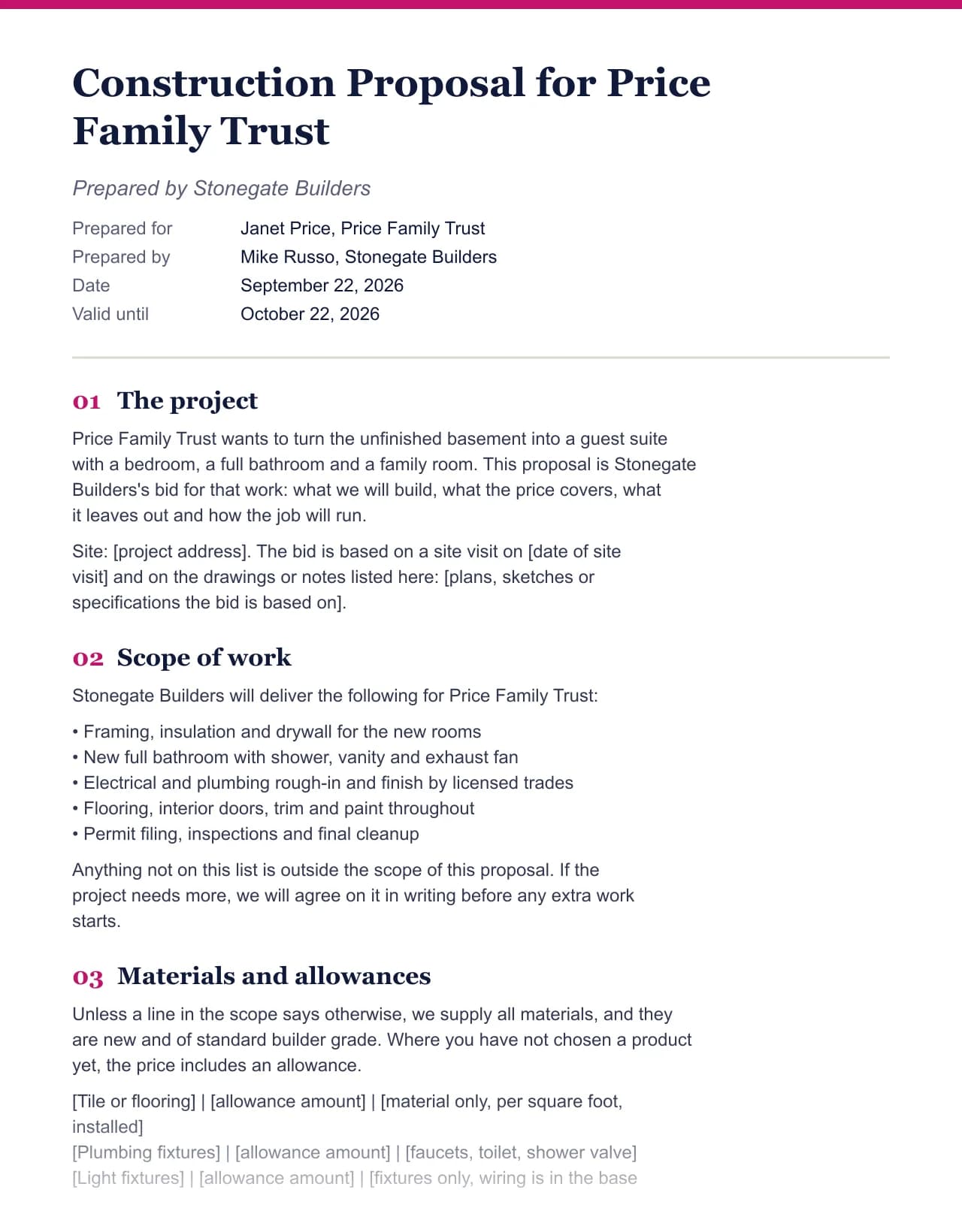
- Test input
- Stonegate Builders (fictional) writing to Price Family Trust, with the default deliverables and prices for this field
- Output
- Construction Proposal, 12 sections
- Words
- 934
- Sections
- 12
- Price options
- 2
- Placeholders left
- 16
- Word file size
- 13 KB
- Generation time
- 1 ms
How we test: every page uses the same input, and we check each output by hand. More on the about page.
The full construction proposal template, section by section
This is the exact text the generator starts from. It is written for a residential remodel, so add trade sections for a large commercial job and trim the allowance table for a small repair.
Text in square brackets is yours to fill in. The tool above fills it for you, and the notes explain why each section is there.
Construction Proposal for [Client company]
- Prepared for
- [Client name], [Client company]
- Prepared by
- [Your name], [Your business]
- Date
- [date]
- Valid until
- [date]
01The project
Why this section: Owners often collect three or more bids for the same job. Restating the project, the site and the goal in your own words shows that you walked the site and that every bid is being compared on the same work.
[Client company] wants to [reach the client's goal]. This proposal is [Your business]'s bid for that work: what we will build, what the price covers, what it leaves out and how the job will run.
Site: [project address]. The bid is based on a site visit on [date of site visit] and on the drawings or notes listed here: [plans, sketches or specifications the bid is based on].
02Scope of work
Why this section: A numbered list of what the client gets is the part they read twice. A clear list also protects you: anything not on it is extra work with an extra price.
[Your business] will deliver the following for [Client company]:
- Framing, insulation and drywall for the new rooms
- New full bathroom with shower, vanity and exhaust fan
- Electrical and plumbing rough-in and finish by licensed trades
- Flooring, interior doors, trim and paint throughout
- Permit filing, inspections and final cleanup
Anything not on this list is outside the scope of this proposal. If the project needs more, we will agree on it in writing before any extra work starts.
03Materials and allowances
Why this section: Finish choices move the price more than labor does. Naming the material grade and listing allowances for items the owner has not picked yet stops a low bid from turning into a surprise invoice later.
Unless a line in the scope says otherwise, we supply all materials, and they are new and of standard builder grade. Where you have not chosen a product yet, the price includes an allowance.
| Allowance item | Amount included | What it covers |
|---|---|---|
| [Tile or flooring] | [allowance amount] | [material only, per square foot, installed] |
| [Plumbing fixtures] | [allowance amount] | [faucets, toilet, shower valve] |
| [Light fixtures] | [allowance amount] | [fixtures only, wiring is in the base scope] |
If your selections cost less than an allowance, the difference comes off the final invoice. If they cost more, the difference is added through a change order before we order the item.
04Not included
Why this section: Exclusions are where bids really differ. An owner comparing prices needs to see what this one leaves out, and a clear list protects the contractor when a hidden problem turns up behind a wall.
The contract price from [Your business] does not include the following items:
- Repair of hidden conditions found after demolition, such as rot, mold, asbestos or work that does not meet code.
- Engineering, architectural drawings or surveys, unless listed in the scope.
- Utility company fees, impact fees and upgrades to the service outside the work area.
- Furniture, appliances and window coverings, unless listed in the scope.
- Landscape repair beyond rough grading of areas our equipment disturbs.
If we find a hidden condition, we stop work in that area, show it to you and price the fix as a change order before we continue.
05Permits, license and insurance
Why this section: Owners carry real risk when a contractor works without a permit or proper coverage. Stating who pulls the permits and listing the license and insurance details answers the first questions a careful owner asks.
- Permits: [Your business] applies for the building permits this work needs and schedules every required inspection. Permit fees are [included in the price or billed at cost].
- Contractor license: [state and license number].
- General liability insurance: [insurer and policy limit]. A certificate of insurance is available on request.
- Workers compensation: [insurer or policy number], covering everyone our company sends to the site.
Work is built to the building code in force when the permit is issued. We do not cover up any work until the inspector has passed it.
06Schedule
Why this section: Clients plan around your dates. So state the length, say when the clock starts and say what happens when feedback is late.
The work takes [timeline, for example 6 weeks] from the day this proposal is accepted and the first payment arrives.
The schedule assumes feedback within two business days at each review point. If materials or approvals arrive later, the dates move by the same number of days.
07Weather and delays
Why this section: Every job loses days to rain, inspections or late materials. Saying up front which delays extend the schedule, and how you will tell the owner, keeps a slipped date from becoming a dispute.
The schedule is our honest plan, not a fixed end date. It moves by the number of days lost to any of these causes, and [Your business] tells [Client company] in writing within two business days when one happens:
- Weather that makes outdoor work unsafe or harms materials, such as rain on open framing or freezing temperatures for concrete.
- Waiting for inspections or permit decisions outside our control.
- Late selections or approvals from the owner, and changes to the work.
- Supply delays on materials that were ordered on time.
08Contract price
Why this section: Show the price in a table next to what it buys. Two or three options let the client choose a level instead of saying yes or no to a single number.
There are 2 options below, so [Client company] can choose the level that fits the budget and the goal.
| Option | What is included | Price |
|---|---|---|
| Base bid | Full scope with builder grade finishes and the stated allowances | [price] |
| Base bid with upgrades | Base bid plus tile shower surround, luxury vinyl plank and a wet bar | [price] |
Payment terms: [payment terms, for example 50% to start and 50% on delivery].
All prices are in USD.
09Payment schedule
Why this section: Construction is paid in stages because the contractor buys materials and pays crews long before the job is done. Tying each payment to a visible milestone lets the owner pay for progress they can see.
The contract price ([price]) is paid in stages tied to progress on site: [payment terms, for example 50% to start and 50% on delivery].
- Deposit on signing, which lets us order materials and book the trades.
- Progress payment when rough framing, plumbing and electrical pass inspection.
- Progress payment when drywall is hung and finished.
- Final payment at substantial completion, after the final inspection and a walkthrough with you.
Invoices are due within [number] days. Approved change orders are billed with the next scheduled payment.
10Change orders
Why this section: Changes during a build are normal, but verbal changes are the most common source of payment disputes in construction. A written change order with price and schedule impact protects both sides.
Any change to the work, whether [Client company] asks for it or a hidden condition requires it, goes through a written change order. Each one states the work, the added or reduced cost and the effect on the schedule.
We start changed work only after both sides sign the change order. Small changes can be approved by email, but they still get a change order number so the final invoice is easy to check.
11Warranty
Why this section: The warranty tells the owner what happens after the crew leaves. A clear period and a clear list of what it covers, and what it does not, is often what tips a close bid.
[Your business] warrants its workmanship for [warranty period] from substantial completion. If something we built fails because of how it was built, we come back and fix it at no charge.
Manufacturer warranties on materials and fixtures pass to you. The warranty does not cover normal wear, damage from misuse or lack of maintenance, or work changed by others after we finish.
12Next steps
Why this section: End with one clear action and a signature block. An expiry date gives the client a reason to decide and protects you from old prices.
To go ahead, sign below and reply to this proposal. We then send the first invoice and book the kickoff call.
This proposal is valid until [date] (30 days).
| [Your business] | [Client company] | |
|---|---|---|
| Name | [Your name] | [Client name] |
| Signature | ||
| Date |
What a construction bid needs that other proposals do not
A homeowner or building owner rarely hires the first contractor who quotes. They lay three bids side by side and look for the differences. So a construction proposal has to make comparison easy: the scope in plain lines, the finish grade, and above all what the price leaves out.
That is why this construction proposal template gives exclusions, allowances and change orders their own sections. A low number with vague exclusions often costs the owner more in the end, and experienced owners know it. When your bid spells out that hidden rot or utility fees are extra, it reads as honest rather than expensive.
Risk is the other difference. The owner is letting a crew into their property, so they want the license number, proof of insurance and a clear answer on who pulls the permits. The template leaves those as bracketed fields, because only you can fill them truthfully.
How to price the work in a construction proposal template
Most small contractors bid a fixed contract price built from materials, labor, subcontractor quotes, overhead and profit. The owner sees one number, or a base bid and an upgrade option. Cost plus pricing, where the owner pays actual cost plus a fee, suits jobs where the scope is still unclear.
Allowances bridge the gap when the owner has not chosen tile, fixtures or lighting yet. You put a sum in the price for each item, and the final invoice adjusts up or down once they pick. Our construction proposal template includes an allowance table so the owner can see those sums before signing.
The payment schedule should follow the work, not the calendar. A deposit on signing, then payments at inspections or visible milestones, then a final payment after the walkthrough. Many states cap the deposit on home improvement work, so check your state's rule before you set it.
Change orders, delays and the warranty
Few jobs finish exactly as bid. The owner changes a finish, or demolition uncovers a problem. In this construction proposal template, the change order section makes every change a signed document with its own price and schedule impact, which keeps the final invoice easy to check.
Likewise, the delay section does the same for time. It names weather, inspections, late selections and supply problems as reasons the schedule can move, and it commits you to telling the owner in writing. Finally, the warranty section tells the owner what happens after you leave, which often decides a close bid.
When this template is not the right fit
Public projects and large commercial jobs usually come with their own bid forms, bonds and contract documents, such as a standard owner and contractor agreement. In that case, use their format and treat this construction proposal template as a checklist of what to cover.
Also, a proposal is not a full construction contract. Lien notices, right to cancel notices and other consumer rules vary by state, so have the final agreement reviewed if the job is large or your state requires specific wording.
Sections in the construction proposal template
| Section | What the owner learns |
|---|---|
| Project description | The site, the goal and the plans the bid is based on |
| Scope of work | Every line of work included in the price |
| Materials and allowances | The finish grade and the sums held for items not yet chosen |
| Exclusions | What the price does not cover, including hidden conditions |
| Permits, license and insurance | Who pulls permits, plus license and coverage details |
| Schedule and delays | How long the job takes and what can move the date |
| Contract price and payments | The bid options and the milestone payment plan |
| Change orders | How changes are priced and approved in writing |
| Warranty | What is covered after completion and for how long |
| Acceptance | The expiry date and a signature block for both sides |
Construction proposal template FAQ
What should a construction proposal include?
It should include the project and site, a scope of work, materials and allowances, exclusions, permits with your license and insurance, a schedule, the contract price, a payment schedule, a change order clause, a warranty and a signature block.
How do I write a construction bid proposal?
Walk the site, list the work in trade order, price materials, labor and subcontractors, then add overhead and profit. Put it all in a construction proposal template like this one so the owner sees scope, exclusions and payments in one document.
Is a construction proposal the same as a contract?
No. The proposal is your offer. Once the owner signs it, it can become part of the agreement, but larger jobs usually add a full contract with the terms your state requires.
How much deposit can a contractor ask for?
It depends on your state. Several states limit the deposit on home improvement work, so check your state contractor board before you set the first payment.
What are allowances in a construction proposal?
Allowances are sums included in the price for items the owner has not chosen yet, such as tile or light fixtures. If the final choice costs more or less, the difference is added or credited.
Is this construction proposal template free?
Yes. Reading the template, generating a filled bid, editing it and downloading the Word file are free with no account. It only uses the prices and details you type in.