Digital marketing proposal template
A digital marketing proposal template sets out the tracking, channel mix, testing plan, ad spend rules, reporting and monthly fees for running paid search, paid social and email. The one below has twelve sections and keeps your management fee apart from the client's ad budget. Read it here or fill it in for free.
By The Clinchdraft team (Product and testing). Last updated .
How to fill in a digital marketing proposal template, step by step
- Ask for read access to the client's ad and analytics accounts before you write anything.
- Note the current spend, conversions and tracking gaps in the details box, since the baseline section builds on them.
- Write the goal in the client's numbers, such as a lower cost per customer at the same order volume.
- List each channel you will run as its own deliverable, so the channel mix and the scope match.
- Add a one time setup fee and one or two monthly options, and say in each note that ad spend is not included.
- Generate the draft, check the ad spend section and send it with a screenshot of one tracking gap you found.
Generating a proposal is free and needs no account. Tailoring it to a client brief uses a credit, so see the pricing page for packs and plans, or read how we test the templates.
Digital marketing proposal template tested with a real input
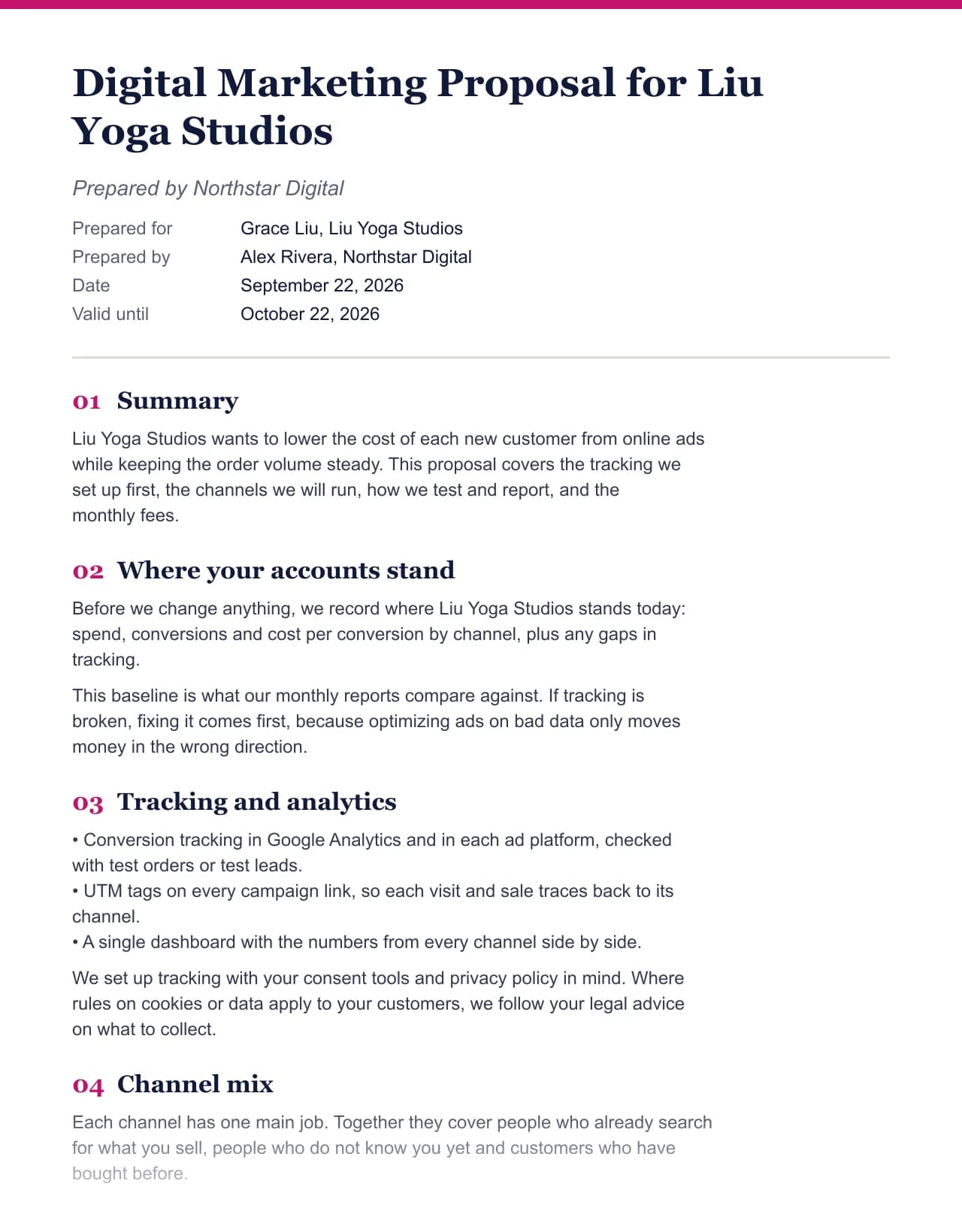
We ran a fictional business and client through this exact generator. Every number below comes from that run, including the size of the Word file the download button produces.
- Test input
- Northstar Digital (fictional) writing to Liu Yoga Studios, with the default deliverables and prices for this field
- Output
- Digital Marketing Proposal, 12 sections
- Words
- 815
- Sections
- 12
- Price options
- 3
- Placeholders left
- 0
- Word file size
- 12 KB
- Generation time
- 1 ms
How we test: every page uses the same input, and we check each output by hand. More on the about page.
The full digital marketing proposal template, section by section
This is the text the generator starts from. It is written for a monthly retainer that runs paid search, paid social and email, so delete the channel rows you do not offer.
Text in square brackets is yours to fill in. The tool above fills it for you, and the notes explain why each section is there.
Digital Marketing Proposal for [Client company]
- Prepared for
- [Client name], [Client company]
- Prepared by
- [Your name], [Your business]
- Date
- [date]
- Valid until
- [date]
01Summary
Why this section: Digital marketing clients think in cost per lead or cost per sale. Opening with their goal and the channels that serve it tells them you will be judged on the same numbers they watch.
[Client company] wants to [reach the client's goal]. This proposal covers the tracking we set up first, the channels we will run, how we test and report, and the monthly fees.
02Where your accounts stand
Why this section: Every channel decision depends on data the client may not trust. A short review of the ad accounts and tracking shows the starting point, so later results have something honest to compare against.
Before we change anything, we record where [Client company] stands today: spend, conversions and cost per conversion by channel, plus any gaps in tracking.
This baseline is what our monthly reports compare against. If tracking is broken, fixing it comes first, because optimizing ads on bad data only moves money in the wrong direction.
03Tracking and analytics
Why this section: Paid channels only improve when conversions are counted correctly. Explaining the tracking setup protects the client from paying for clicks that nobody can tie to a sale or a lead.
- Conversion tracking in Google Analytics and in each ad platform, checked with test orders or test leads.
- UTM tags on every campaign link, so each visit and sale traces back to its channel.
- A single dashboard with the numbers from every channel side by side.
We set up tracking with your consent tools and privacy policy in mind. Where rules on cookies or data apply to your customers, we follow your legal advice on what to collect.
04Channel mix
Why this section: Clients want to see why each channel earns its share of the budget. A table of channels with a clear job for each one prevents the sense that money gets spread everywhere at once.
Each channel has one main job. Together they cover people who already search for what you sell, people who do not know you yet and customers who have bought before.
| Channel | Main job | What we do |
|---|---|---|
| Paid search | Capture people already searching | Keywords, ads, bids and negative keywords, reviewed weekly |
| Paid social | Reach new people and bring visitors back | Audiences, creative testing and retargeting |
| Turn subscribers into repeat buyers | Campaigns, automated flows and list hygiene | |
| Analytics | Tie every channel to results | Conversion tracking, UTM tags and the monthly dashboard |
The deliverables below list the exact channels included. Therefore any new channel, such as video ads or affiliate programs, is a separate conversation.
05Testing and optimization
Why this section: The difference between running ads and managing them is a testing plan. Describing the rhythm of tests and budget shifts shows the client what the monthly fee pays for after setup.
Every month we test a small number of changes, such as a new headline, audience or landing page. We run each test long enough to reach a fair result, then keep the winner and move on.
Budget follows results. When one campaign returns more for each dollar spent, we move budget toward it within the total you approved, and we explain every shift in the next report.
06Scope and deliverables
Why this section: A numbered list of what the client gets is the part they read twice. A clear list also protects you: anything not on it is extra work with an extra price.
[Your business] will deliver the following for [Client company]:
- Tracking audit and conversion setup in Google Analytics and the ad platforms
- Google Ads search campaigns: structure, keywords, ads and weekly optimization
- Meta ads for prospecting and retargeting, with new creative each month
- Two email campaigns per month and one automated welcome series
- Monthly performance report and review call
Anything not on this list is outside the scope of this proposal. If the project needs more, we will agree on it in writing before any extra work starts.
07Ad spend
Why this section: Management fees and ad spend often get mixed up in this field. Stating that the platforms bill the client directly, and that we never exceed the approved budget, removes a common money worry.
Ad spend is separate from our fees. Google, Meta and the email platform bill [Client company] directly, on your own payment method and in your own accounts.
You set the monthly ad budget, and we stay within it. Any increase needs your written approval first, even when a campaign performs well.
08Reporting
Why this section: Monthly reports are where the client decides whether to keep the retainer. Tying the report to the baseline and the goal keeps the review about business results rather than clicks and impressions.
Each month [Client company] gets a report and a review call. It shows spend, conversions and cost per conversion for each channel against the baseline, plus email revenue or leads where tracking allows.
We do not promise a fixed return on ad spend, since competition, pricing and seasons move the results. We do promise clear numbers, the tests we ran and the plan for next month.
09Timeline
Why this section: Clients plan around your dates. So state the length, say when the clock starts and say what happens when feedback is late.
The work takes [timeline, for example 6 weeks] from the day this proposal is accepted and the first payment arrives.
The schedule assumes feedback within two business days at each review point. If materials or approvals arrive later, the dates move by the same number of days.
10Management fees
Why this section: Show the price in a table next to what it buys. Two or three options let the client choose a level instead of saying yes or no to a single number.
There are 3 options below, so [Client company] can choose the level that fits the budget and the goal.
| Option | What is included | Price |
|---|---|---|
| Setup | One time: tracking audit, conversion setup and account restructure | [price] |
| Paid media | Per month: Google Ads and Meta ads management, ad spend not included | [price] |
| Paid media and email | Per month: everything in Paid media plus email campaigns and automation | [price] |
Payment terms: [payment terms, for example 50% to start and 50% on delivery].
All prices are in USD.
11Terms
Why this section: Ad accounts hold years of data and audiences. The terms must say the client owns them, that email follows anti spam law, and how either side can end a monthly retainer without losing access.
- Accounts and data: [Client company] owns all ad, analytics and email accounts, and we work in them through user access you can remove at any time.
- Email rules: every campaign follows the CAN-SPAM Act, including a working unsubscribe link and your physical address.
- Term: after the first term above, the work continues month to month until either side gives 30 days written notice.
- Changes: new channels, landing page builds or video production get a separate quote.
12Next steps
Why this section: End with one clear action and a signature block. An expiry date gives the client a reason to decide and protects you from old prices.
To go ahead, sign below and reply to this proposal. We then send the first invoice and book the kickoff call.
This proposal is valid until [date] (30 days).
| [Your business] | [Client company] | |
|---|---|---|
| Name | [Your name] | [Client name] |
| Signature | ||
| Date |
What goes into a digital marketing proposal template
A digital marketing proposal sells ongoing management of channels that can be measured every day. So the client reads it with a spreadsheet mindset. Where does the money go, how will we know it works, and what happens when it does not?
This digital marketing proposal template answers those questions in order. First comes a baseline of the current accounts. Then tracking, because bad conversion data makes every later decision worse. After that, the channel mix explains the job of paid search, paid social, email and analytics in one table.
Brand strategy, positioning and offline campaigns are not part of this template. For that broader kind of project, use the marketing proposal template instead. Keeping the two apart makes each proposal shorter and easier to approve.
Management fee vs ad spend
A line that often causes confusion in this field is the one between your fee and the client's media budget. The template gives ad spend its own section. It says the platforms bill the client directly and that you never go over the approved budget without written consent.
That setup protects both sides. You do not front ad costs on your own card, and the client keeps full control of the accounts and their history. Also, if the retainer ends, the campaigns, audiences and data stay with the client.
How to price a digital marketing proposal
Three pricing models are common. A flat monthly fee is the simplest to approve. By contrast, a percentage of ad spend scales with the account, but it can reward spending more rather than spending well. A performance fee ties pay to results, yet it only works when tracking is trustworthy.
Our digital marketing proposal template uses a one time setup fee plus flat monthly options. For example, setup covers the tracking audit and account restructure, while the monthly plans cover paid media alone or paid media with email. Each note says per month and states that ad spend is extra.
Whatever model you pick, write it in one sentence. The client should be able to explain your fee to their finance team without calling you.
When this digital marketing proposal template is not the right fit
If the client wants organic growth from search, the SEO proposal template has the audit, content and reporting sections that work needs. Similarly, if the job is mostly organic posting and community replies, the social media proposal template is the better start.
The template also assumes the client has a website that can convert visitors. When the landing pages are the real problem, propose a web design project first, or add the page build as a separate line item.
Pricing models for a digital marketing proposal
| Model | How it works and when it fits |
|---|---|
| Flat monthly fee | The same fee each month for a fixed scope. Easy to approve and to budget |
| Percentage of ad spend | The fee grows with the budget. Suits large accounts, but can reward spending more |
| Performance fee | Pay tied to leads or sales. Needs tracking both sides trust |
| Setup fee | A one time charge for tracking, audits and account structure before month one |
| Hybrid | A lower flat fee plus a bonus on agreed results |
Digital marketing proposal template FAQ
What should a digital marketing proposal include?
It should include a summary, the current baseline, a tracking plan, the channel mix, a testing plan, scope, ad spend rules, reporting, timeline, management fees, terms and a signature block. This digital marketing proposal template has all of them.
How do I write a digital marketing proposal?
Start from the client's accounts and numbers, then explain which channels you will run and why. Set out how you track, test and report, and keep your fee separate from the ad budget. The form on this page writes that structure for you.
How much should I charge for digital marketing services?
Many agencies charge a setup fee plus a flat monthly management fee, while others take a percentage of ad spend. Base your price on the hours each channel takes you and never mix it with the client's media budget.
What is the difference between a marketing proposal and a digital marketing proposal?
A marketing proposal covers brand, positioning and a campaign that can include print and events. A digital marketing proposal covers the ongoing management of online channels such as paid search, paid social and email.
Should a digital marketing proposal promise a return on ad spend?
No. Competition, pricing and seasons move the results, and none of them are in your control. Promise clear tracking, regular tests and honest monthly reports instead.
Is this digital marketing proposal template free?
Yes. Reading it, filling it in, editing it and downloading the Word file are free with no account. Only the AI step that tailors a draft to a pasted client brief uses credits.