Grant proposal template
A grant proposal template gives a nonprofit the sections most foundations ask for: summary, organization background, need statement, goals and objectives, methods, evaluation plan, budget, sustainability and an attachments list. Read the full template below, or fill in the short form to get a draft you can edit and download as a Word file, free.
By The Clinchdraft team (Product and testing). Last updated .
How to fill in a grant proposal template, step by step
- Read the funder's guidelines first and note their page limit, required headings and deadline.
- Enter your organization as the applicant and the foundation or agency as the recipient.
- Write the program goal as a verb phrase, such as help 60 students raise their reading level by one grade.
- List four to six objectives or outputs, one per line, so each can be measured in the evaluation plan.
- Add the amount you request, or two funding levels, and name each level by what it pays for.
- Generate the draft, then replace every bracketed placeholder with your own data and sources before you submit.
Generating a proposal is free and needs no account. Tailoring it to a client brief uses a credit, so see the pricing page for packs and plans, or read how we test the templates.
Grant proposal template tested with a real input
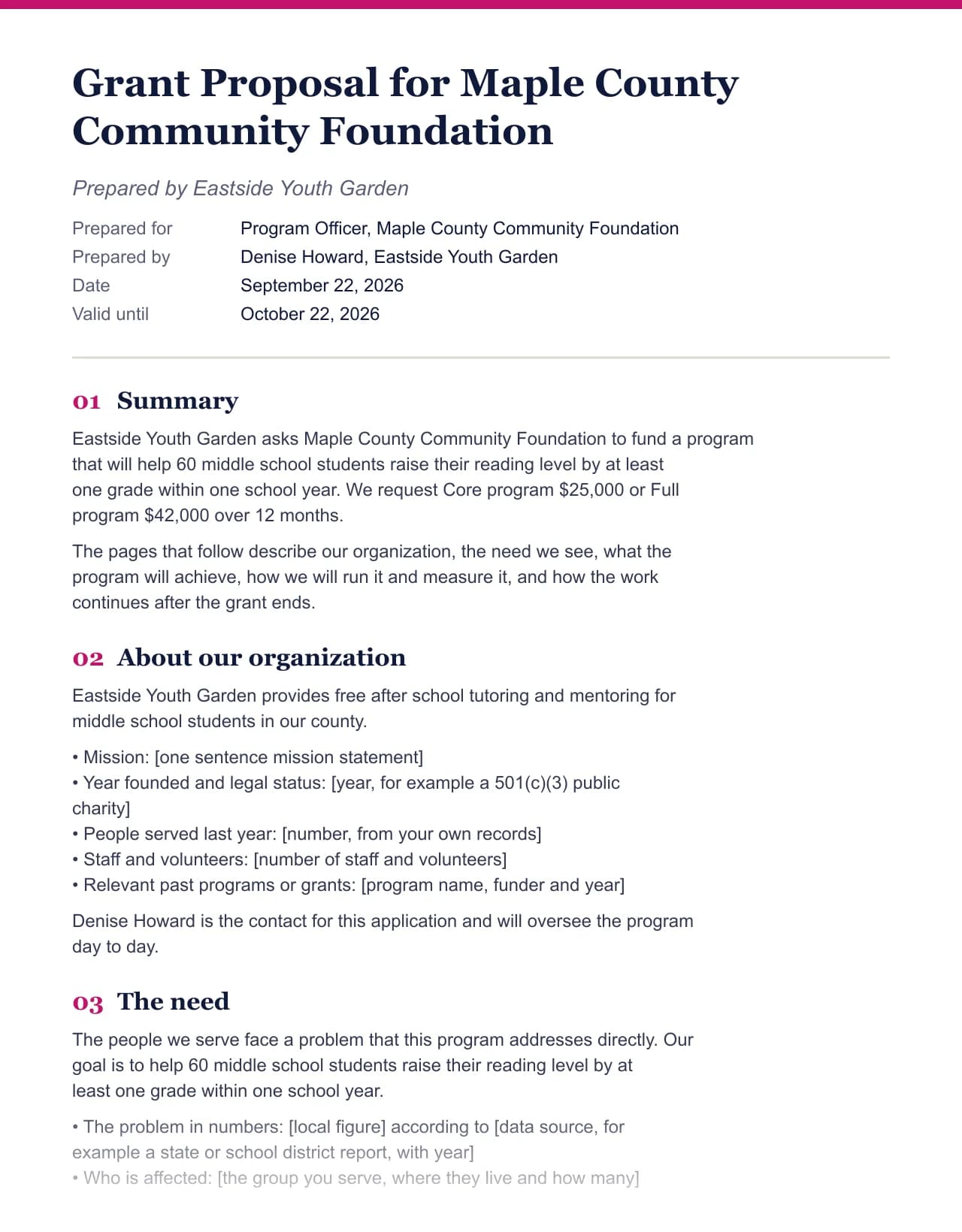
We ran a fictional business and client through this exact generator. Every number below comes from that run, including the size of the Word file the download button produces.
- Test input
- Eastside Youth Garden (fictional) writing to Maple County Community Foundation, with the default deliverables and prices for this field
- Output
- Grant Proposal, 10 sections
- Words
- 755
- Sections
- 10
- Price options
- 2
- Placeholders left
- 21
- Word file size
- 12 KB
- Generation time
- 2 ms
How we test: every page uses the same input, and we check each output by hand. More on the about page.
The full grant proposal template, section by section
This is the exact text the generator starts from. It is written for a one year community program, so shorten it for a letter of inquiry and expand the methods and evaluation for a large multi year request.
Text in square brackets is yours to fill in. The tool above fills it for you, and the notes explain why each section is there.
Grant Proposal for [Client company]
- Prepared for
- [Client name], [Client company]
- Prepared by
- [Your name], [Your business]
- Date
- [date]
- Valid until
- [date]
01Summary
Why this section: Program officers screen many applications and often read only the first page closely. The summary states who you are, the need, the request and the result you expect before anything else.
[Your business] asks [Client company] to fund a program that will [reach the client's goal]. We request [price] over [timeline, for example 6 weeks].
The pages that follow describe our organization, the need we see, what the program will achieve, how we will run it and measure it, and how the work continues after the grant ends.
02About our organization
Why this section: Funders give money to organizations they trust to spend it well. This section shows your mission, your track record and your capacity to run the program, stated plainly and without claims you cannot document.
[Your business] provides [what you do, in one line].
- Mission: [one sentence mission statement]
- Year founded and legal status: [year, for example a 501(c)(3) public charity]
- People served last year: [number, from your own records]
- Staff and volunteers: [number of staff and volunteers]
- Relevant past programs or grants: [program name, funder and year]
[Your name] is the contact for this application and will oversee the program day to day.
03The need
Why this section: The need statement is where most grants are won or lost. It must show a real, documented problem in your community, with data from named public sources, and link that problem to what you propose.
The people we serve face a problem that this program addresses directly. Our goal is to [reach the client's goal].
- The problem in numbers: [local figure] according to [data source, for example a state or school district report, with year]
- Who is affected: [the group you serve, where they live and how many]
- What happens if nothing changes: [the cost of inaction, backed by a source]
- Why current services fall short: [gap in existing programs]
Every figure in this section comes from a named source listed in the attachments, so reviewers can check it.
04Goals and objectives
Why this section: Reviewers score objectives on whether they are specific and measurable. One clear goal with a short list of concrete outputs gives the funder something to hold you to and gives you something to report on.
Goal: [reach the client's goal].
To reach that goal, [Your business] will deliver the following with support from [Client company]:
- Weekly small group reading sessions for 60 students across two school sites
- Training for 20 volunteer tutors before the first session
- Reading assessments for every student at intake, midyear and year end
- Monthly family workshops on reading at home
- A year end outcomes report shared with the funder and partner schools
Each objective has a target number and a date in the evaluation plan below, so progress can be tracked from the first month.
05How we will do it
Why this section: The methods section shows the funder that you have thought through the work, not only the result. Explain who does what, in what order, with which partners, and why this approach fits the need.
The program runs for [timeline, for example 6 weeks] in three stages.
- Launch: hire or assign staff, recruit and train volunteers, confirm partner sites and set baseline measures.
- Delivery: run the core activities on a fixed schedule, track attendance and fix problems as they appear.
- Close and report: collect final measures, review what worked with partners and share results with the funder.
Partners: [partner organizations and their role]. Why this approach: [evidence or past experience that supports it].
06How we will measure results
Why this section: Funders need to report results to their own board. A plan that names what you will measure, how often and with which tool makes your grant easy to renew and easy to defend.
| What we measure | How | When |
|---|---|---|
| Participation | Attendance and enrollment records | Monthly |
| Progress toward the goal | [assessment tool or survey] | At intake, midpoint and end |
| Participant and partner feedback | Short surveys and interviews | Midpoint and end |
[Your business] will share a progress update at the midpoint and a final report at the end of the [timeline, for example 6 weeks] grant period, or on the schedule [Client company] requires.
07Budget
Why this section: Funders read the budget to check that the request matches the activities. Show the amount, what it pays for and any other funding, so the program officer can see the project is realistic and fully costed.
There are 2 options below, so [Client company] can choose the level that fits the budget and the goal.
| Option | What is included | Price |
|---|---|---|
| Core program | One school site, 30 students, tutor training and assessments | [price] |
| Full program | Two school sites, 60 students, family workshops and the outcomes report | [price] |
Payment terms: [payment terms, for example 50% to start and 50% on delivery].
All prices are in USD.
08Budget notes
Why this section: A budget table alone raises questions. Short notes that tie each cost to an activity show reviewers that the numbers are reasonable and that nothing is padded.
The request of [price] covers the program activities described above. Attach a line item budget with these categories:
- Personnel: [staff time on the program and how it was calculated]
- Program supplies and materials: [items and cost basis]
- Space, travel and other direct costs: [items]
- Indirect costs: [rate, if the funder allows it]
- Other funding secured or requested for this program: [source and amount]
09After the grant
Why this section: Most funders do not want to be the only source forever. Showing how the program continues after the grant, through other funders, earned income or partners, makes the request a safer investment.
This grant covers [timeline, for example 6 weeks]. After that, [Your business] plans to keep the program running through the sources below.
- Other foundations and public funders: [names or types]
- Individual donors and events: [plan]
- Partner contributions or in kind support: [partner and what they give]
10Contact and attachments
Why this section: Funders reject complete proposals for missing documents. A checklist of attachments and one named contact person make the application easy to process and easy to follow up on.
Questions about this proposal can go to [Your name] at [Your business]. The budget figures hold until [date].
- IRS determination letter or proof of nonprofit status
- Board of directors list
- Most recent audited financial statements or Form 990
- Current operating budget
- Line item program budget
- Letters of support from partners
What makes a grant proposal different
A sales proposal asks a client to buy something for themselves. A grant request asks a funder to pay for a change in someone else's life. So the reader is judging two things at once: whether the problem is real, and whether your organization is the right one to fix it with their money.
That is why this grant proposal template puts the need statement before the objectives, and the evaluation plan right after the methods. Reviewers want to see a documented problem, a specific goal that answers it, a plan to reach the goal, and a way to prove you did. However, when one link in that chain is missing, the whole request looks weaker.
Grant writing also has a paperwork side that client proposals do not. For example, most foundations ask for proof of tax exempt status, a board list, financial statements and a line item budget. Therefore, the closing section of the grant proposal template lists them, so nothing is left out on deadline day.
How to write the need statement and budget
The need statement is where reviewers look for evidence. Use recent figures from named public sources, such as census data, a school district report or a state health department survey, and cite each one. For this reason, the grant proposal template leaves those figures as placeholders on purpose, because a made up statistic can end a relationship with a funder for good.
Likewise, the budget in our grant proposal template follows the same rule. The table shows the amount you request, and the budget notes tie each cost to an activity: staff time, supplies, space and, if the funder allows it, indirect costs. Also mention other funding you have secured or requested, since most foundations prefer to share a program with other supporters.
Finally, keep the numbers consistent. The amount in the summary, the budget table and any cover letter must match, and the generator writes all of them from the same form so they do.
When this grant proposal template is not the right fit
Federal grants on grants.gov come with a notice of funding opportunity, standard forms and strict page rules. In that case, follow that notice exactly and use this template only as a checklist. This also applies to any foundation with its own online application portal and fixed questions.
Similarly, research grants to agencies such as the NSF or NIH have their own structure too, with specific aims, research strategy and biosketches. For an academic study, the research proposal template on this site is a closer match. For a short letter of inquiry, cut this template down to the summary, need, goal and budget request.
Sections in the grant proposal template
| Section | What the funder learns |
|---|---|
| Summary | Who you are, what you ask for, how much and for how long |
| Organization background | Your mission, history and capacity to run the program |
| Statement of need | The documented problem, with named data sources |
| Goals and objectives | The result you aim for and the outputs that lead to it |
| Methods and activities | Who does what, in what order and with which partners |
| Evaluation plan | What you will measure, how and when you will report it |
| Budget and budget notes | The amount requested and what each part pays for |
| Sustainability | How the program continues after the grant period |
| Contact and attachments | Who to call and the documents that must come with the application |
Grant proposal template FAQ
What should a grant proposal include?
Most foundations expect a summary, an organization background, a statement of need, goals and objectives, methods, an evaluation plan, a budget, a sustainability plan and supporting attachments. Always check the funder's own guidelines, because their headings take priority.
How do I write a grant proposal for a nonprofit?
Start with the funder's guidelines, then write the need statement with sourced data, set one clear goal with measurable objectives, and explain your methods and evaluation. Then build the budget last so every cost ties to an activity you already described.
How long should a grant proposal be?
In general, length depends on the funder. Many private foundations set a limit of a few pages, while federal applications can run much longer. The generated draft from this template is a starting point you trim to the funder's limit.
Is this grant proposal template free?
Yes. Reading the template, generating a filled draft, editing it and downloading the Word file are free with no account. Only the AI step that tailors a draft to pasted funder guidelines uses credits.
Can I use the template for a federal grant?
Yes, but only as a checklist and a first draft of your narrative. Federal applications have required forms and a notice of funding opportunity that set the exact format, so follow that notice over this template.
Does the generator add statistics to the need statement?
No. It fills the template only with what you type in the form. Data, past results and attachments stay as bracketed placeholders until you add your own sourced information.