AI proposal writer
An AI proposal writer should save you the blank page without putting words in your mouth. Ours drafts a complete proposal from a short form, then rewrites it in the client's words from their brief, using only your facts. Below are the writing habits that turn that draft into a proposal a client can approve quickly.
By The Clinchdraft team (Product and testing). Last updated .
How to use the AI proposal writer, step by step
- Pick the proposal type that matches the work, such as marketing, SEO or software development.
- Write the client's goal as a result they want, not as a task you will do.
- List deliverables a client can check off, and give each price option a name that says what it buys.
- Pick a tone, press Generate and read the draft out loud once.
- Paste the client brief into the tailoring box and fix any requirement with no matching section.
- Then run the AI rewrite if you want the client's wording, and edit the last details by hand.
Generating a proposal is free and needs no account. Tailoring it to a client brief uses a credit, so see the pricing page for packs and plans, or read how we test the templates.
AI proposal writer tested with a real input
We ran a fictional business and client through this exact generator. Every number below comes from that run, including the size of the Word file the download button produces.
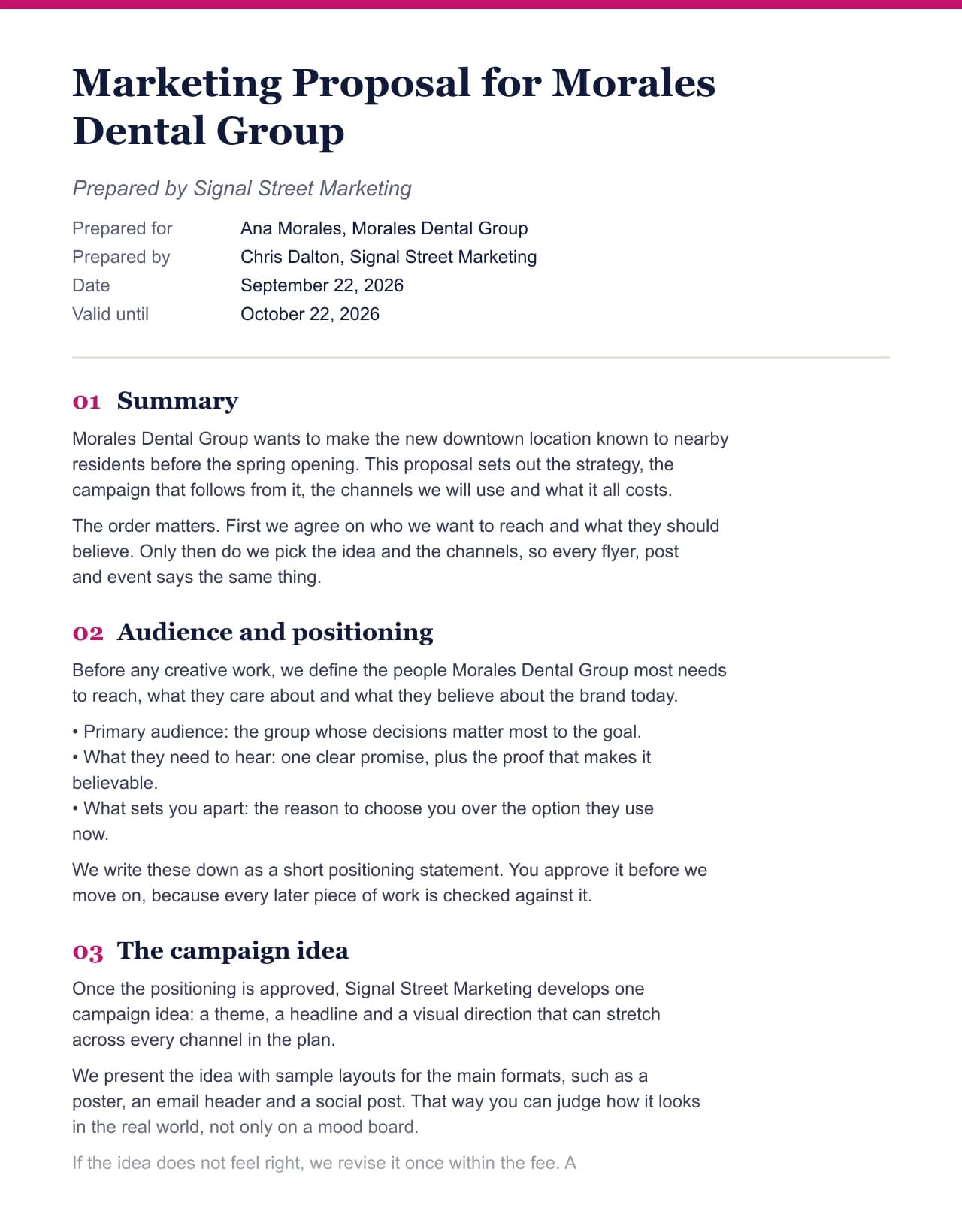
- Test input
- Signal Street Marketing (fictional) writing to Morales Dental Group, with the default deliverables and prices for this field
- Output
- Marketing Proposal, 12 sections
- Words
- 910
- Sections
- 12
- Price options
- 3
- Placeholders left
- 0
- Word file size
- 13 KB
- Generation time
- 1 ms
How we test: every page uses the same input, and we check each output by hand. More on the about page.
What a good AI proposal writer does, and what it should not
Good writing help removes the slow parts: the structure, the transitions, the terms you rewrite for every client. It should not decide your scope, your price or your credentials. Those are commitments, and a client will hold you to them.
That is how our AI proposal writer is split. The draft comes from hand written sections for 19 fields, filled only with what you type. Then an optional AI step reads the client's brief and rewrites the text in their words, under a rule that it must not add numbers, clients, results or guarantees. If a fact is missing, you get a [placeholder] instead of a guess.
The AI step has three free runs a day and uses one credit per run after that. Everything else, including editing, copying and the Word download, is free.
Writing habits that make a proposal easy to approve
First, open with the client's goal in their words. The person who reads your proposal is often not the one who has to approve it, so the first paragraph must make sense to someone who missed the call. Name the goal, the approach in one line and the price.
Second, make every deliverable checkable. Instead of improve your website, write a redesigned home page and five inner pages in your current platform. Specific lines protect you from scope creep and make the price easier to accept.
Third, offer options instead of one number. Two or three price levels, each named for what it buys, let the client choose between your offers rather than decide yes or no. Finally, end with one clear next step and a date the proposal expires.
Edit the AI draft before a client sees it
Read the draft out loud once. Anything you would not say to the client on a call, such as stiff phrases or claims you cannot back up, should go. Plain language guidelines from the U.S. government make the same point: short sentences, active voice and common words.
Next, search for square brackets. Every [placeholder] is a fact the tool refused to guess, and one left in a sent proposal looks careless. After that, check the numbers against your form, even though the tool keeps them as typed.
Last, remember what the tool does not do. There is no e-signature, payment link or view tracking, so you send the Word file or PDF yourself and follow up by email or phone.
Who writes what in the proposal
| Part of the proposal | Who writes it |
|---|---|
| Scope, deliverables and prices | You, in the form, kept exactly as typed |
| Structure and section order | The template for your field |
| Summary, approach and terms prose | The template, filled with your facts |
| Answers to the client's questions | The AI rewrite, from your facts and the brief |
| Wording that mirrors the client | The AI rewrite, one credit per run |
| Proof, results and case studies | Only you, never the tool |
AI proposal writer FAQ
What is the best AI proposal writer for freelancers?
Look for one that keeps your prices and scope exactly as you typed them and never invents results. Also check what is free, since many tools charge a monthly seat just to draft.
Can an AI proposal writer write the whole proposal?
It can write most of the text, but not the facts. You still supply the client's goal, the deliverables, the price and any proof, and you should read every line before sending.
How do I make an AI written proposal sound like me?
Pick the tone that matches how you talk to clients, then edit the opening and closing by hand. Those two paragraphs carry most of your voice.
Will clients know the proposal was written with AI?
They notice generic claims and filler more than the tool behind them. A proposal with specific deliverables, real prices and the client's own words reads as yours.
Is this AI proposal writer free?
Drafting, editing and downloading are free with no account. The AI rewrite for a client brief has three free runs a day, then uses credits.