Service proposal template
A service proposal template is a ready outline for offering a one-off or recurring service: overview, service description, scope, service levels, schedule, responsibilities on both sides, term, fees, renewal and cancellation, terms and sign-off. Read the full template below, or fill in the form to get a finished proposal you can edit and download free.
By The Clinchdraft team (Product and testing). Last updated .
How to fill in a service proposal template, step by step
- Start with the problem the client wants gone, written as a goal, such as keep the office network running without an in-house IT person.
- List each recurring task and each one-off task on its own line, so the scope shows exactly what the fee covers.
- Fill in the service levels: your hours, how fast you respond to urgent and routine requests, and how clients reach you.
- Enter one to three fee options and say in each note whether the price is per month, per visit or for the whole job.
- Next, set the term and the notice period, then press Generate and edit any section in place.
- Finally, download the Word file and send it while the client still remembers the call.
Generating a proposal is free and needs no account. Tailoring it to a client brief uses a credit, so see the pricing page for packs and plans, or read how we test the templates.
Service proposal template tested with a real input
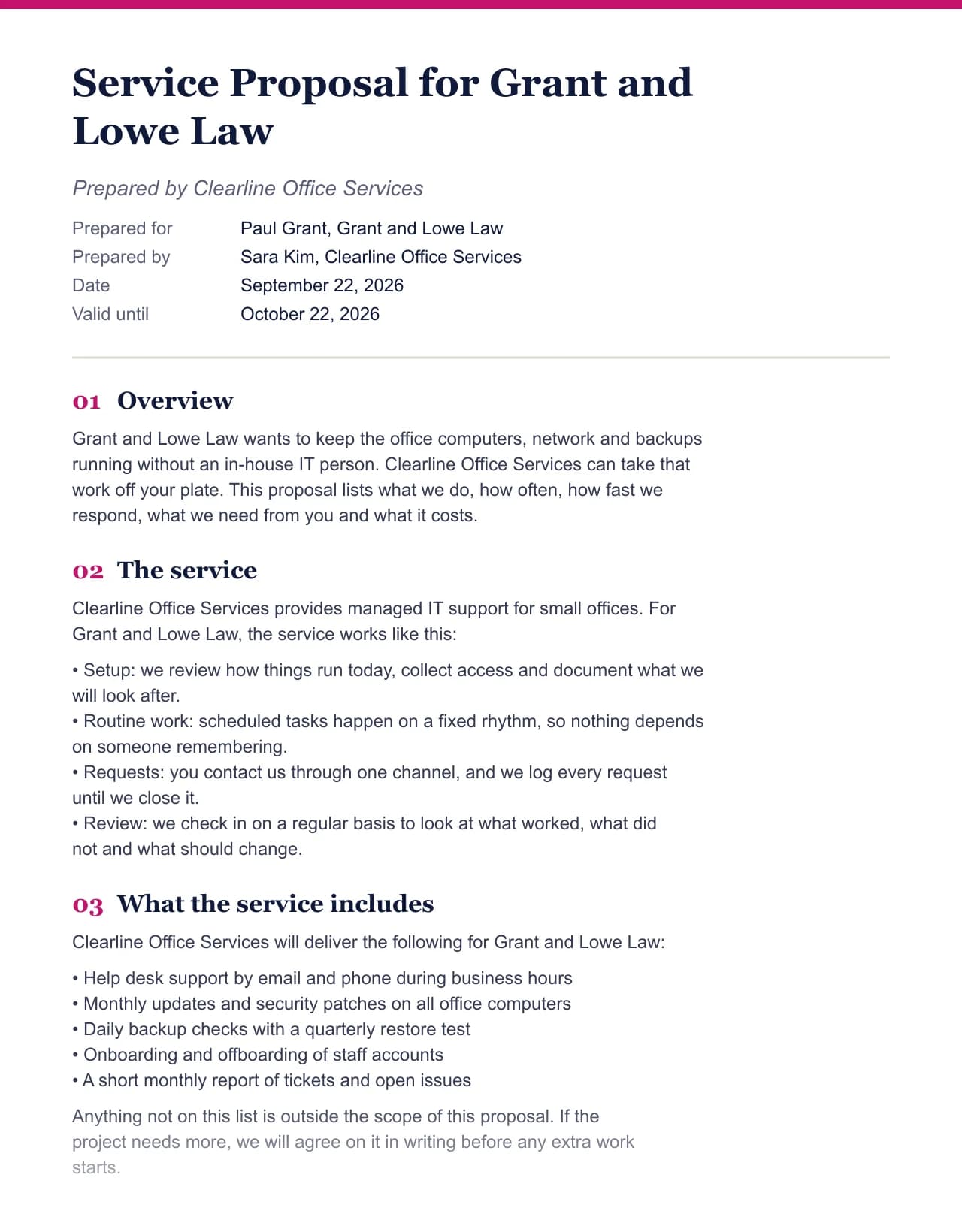
We ran a fictional business and client through this exact generator. Every number below comes from that run, including the size of the Word file the download button produces.
- Test input
- Clearline Office Services (fictional) writing to Grant and Lowe Law, with the default deliverables and prices for this field
- Output
- Service Proposal, 11 sections
- Words
- 735
- Sections
- 11
- Price options
- 2
- Placeholders left
- 7
- Word file size
- 12 KB
- Generation time
- 1 ms
How we test: every page uses the same input, and we check each output by hand. More on the about page.
The full service proposal template, section by section
This is the exact text the generator starts from. It is written for a monthly service, so for a one-off job shorten the renewal section and describe the visit or project instead of a routine.
Text in square brackets is yours to fill in. The tool above fills it for you, and the notes explain why each section is there.
Service Proposal for [Client company]
- Prepared for
- [Client name], [Client company]
- Prepared by
- [Your name], [Your business]
- Date
- [date]
- Valid until
- [date]
01Overview
Why this section: A service buyer usually has a recurring problem they are tired of handling. Opening with that problem and the outcome they want tells them this proposal is about their situation, not a generic menu.
[Client company] wants to [reach the client's goal]. [Your business] can take that work off your plate. This proposal lists what we do, how often, how fast we respond, what we need from you and what it costs.
02The service
Why this section: Clients cannot see a service before they buy it. Describing how the work actually happens, step by step, turns an abstract promise into something they can picture and check.
[Your business] provides [what you do, in one line]. For [Client company], the service works like this:
- Setup: we review how things run today, collect access and document what we will look after.
- Routine work: scheduled tasks happen on a fixed rhythm, so nothing depends on someone remembering.
- Requests: you contact us through one channel, and we log every request until we close it.
- Review: we check in on a regular basis to look at what worked, what did not and what should change.
03What the service includes
Why this section: A numbered list of what the client gets is the part they read twice. A clear list also protects you: anything not on it is extra work with an extra price.
[Your business] will deliver the following for [Client company]:
- Help desk support by email and phone during business hours
- Monthly updates and security patches on all office computers
- Daily backup checks with a quarterly restore test
- Onboarding and offboarding of staff accounts
- A short monthly report of tickets and open issues
Anything not on this list is outside the scope of this proposal. If the project needs more, we will agree on it in writing before any extra work starts.
04Service levels
Why this section: Response times and working hours are what a service client actually buys. Writing them down sets expectations before the first urgent request and gives both sides a fair way to judge the service.
| Measure | Our commitment |
|---|---|
| Service hours | [days and hours, for example Monday to Friday, 8 am to 6 pm] |
| Response to urgent requests | [response time for urgent requests] |
| Response to routine requests | [response time for routine requests] |
| How to reach us | [email, phone or ticket link] |
Response time means the time until a person starts working on the request, not the time until it is solved. We handle requests outside service hours on the next working day, unless you mark them urgent.
05Schedule
Why this section: Recurring service lives on a rhythm: daily, weekly, monthly or on call. Spelling out that rhythm tells the client when to expect you and makes a missed visit or task easy to notice.
Routine work follows this rhythm: [daily, weekly or monthly tasks and the day they happen]. [Your business] schedules visits or work windows in advance so they do not clash with your busiest hours.
If a scheduled task has to move, we tell you at least one business day ahead and agree on a new time.
06Who does what
Why this section: Most service disputes come from an unstated assumption about who handles what. A short two sided list of responsibilities settles that before it turns into a missed task and a frustrated client.
[Your business] will:
- Deliver the services in the scope, on schedule and to the service levels above.
- Name one main contact and a backup, so requests never wait on one person.
- Tell you promptly about any problem we find, even outside the scope.
[Client company] will:
- Give us the access, information and working space the service needs.
- Name one person who can approve work and answer questions.
- Send requests through the agreed channel so nothing gets lost.
07Start date and term
Why this section: Clients plan around your dates. So state the length, say when the clock starts and say what happens when feedback is late.
The work takes [timeline, for example 6 weeks] from the day this proposal is accepted and the first payment arrives.
The schedule assumes feedback within two business days at each review point. If materials or approvals arrive later, the dates move by the same number of days.
08Fees
Why this section: Show the price in a table next to what it buys. Two or three options let the client choose a level instead of saying yes or no to a single number.
There are 2 options below, so [Client company] can choose the level that fits the budget and the goal.
| Option | What is included | Price |
|---|---|---|
| Essential | Per month: help desk, updates and backup checks | [price] |
| Complete | Per month: Essential plus onsite visits and account management | [price] |
Payment terms: [payment terms, for example 50% to start and 50% on delivery].
All prices are in USD.
09Renewal and cancellation
Why this section: A client signs more easily when leaving is clear. Stating how the term renews, how much notice either side gives and how the handover works lowers the risk of saying yes.
- Term: the service runs for [timeline, for example 6 weeks], then renews for the same period unless either side gives notice.
- Notice: either side can end the service with [notice period, for example 30 days] written notice.
- Handover: when the service ends, [Your business] returns all access, documents and data that belong to [Client company].
- Fee changes: we announce any change to fees at renewal in writing at least [notice period] before it applies.
10Terms
Why this section: Service agreements run for months, so small terms matter. Confidentiality, extra work and billing rules written up front prevent friction every month after that.
- Payment: [payment terms, for example 50% to start and 50% on delivery]. We send invoices at the start of each billing period.
- Extra work: requests outside the scope are quoted first and done only after written approval.
- Confidentiality: [Your business] keeps all information from [Client company] confidential and uses it only to deliver the service.
- Liability: each side is responsible for its own staff and its own mistakes.
11Next steps
Why this section: End with one clear action and a signature block. An expiry date gives the client a reason to decide and protects you from old prices.
To go ahead, sign below and reply to this proposal. We then send the first invoice and book the kickoff call.
This proposal is valid until [date] (30 days).
| [Your business] | [Client company] | |
|---|---|---|
| Name | [Your name] | [Client name] |
| Signature | ||
| Date |
What a service proposal template has to cover
A product proposal can point at the product. A service proposal cannot, because the client is buying work that has not happened yet. So the document has to describe the service in enough detail that the client can picture a normal week with you, and notice when something is missing.
That is why this service proposal template separates the service description, the scope and the service levels. First, the description explains how the work flows. Next, the scope lists each task the fee covers, line by line. Finally, the service levels say how fast you respond and when you work, which is what most clients really compare between providers.
Most proposals skip the two sided responsibilities list. Yet many service complaints start with a missing password, a locked door or nobody to approve a decision. Writing down what the client provides protects your schedule and your reputation.
How to price a service proposal
Most providers price recurring services per month, per visit or per unit, such as per user, per location or per square foot. A flat monthly fee is easiest for clients to budget, and it rewards you for running the service efficiently. However, it needs a clear scope, or small extras will eat the margin.
One-off services work better with a fixed price for a defined job, or an hourly rate with an estimate. In either case, our service proposal template shows up to three options in a table, each with a note. So state in that note whether a price is monthly, per visit or for the full job.
Also, decide in advance how extra work is billed. The terms section says that anything outside the scope is quoted first, which lets you say yes to a request without giving the work away.
Renewal, cancellation and the client's risk
A client weighing a twelve month commitment worries about getting stuck with a provider who stops caring. A clear notice period and a handover promise lower that risk, and they often make the difference between a signature and a polite delay.
For this reason, the service proposal template states the term, how it renews, how much notice each side gives and what you hand back at the end. You announce fee changes at renewal in writing, so the client never finds a new price on an invoice.
When this template is not the right fit
If your field has its own proposal page on this site, such as cleaning, catering, SEO or web design, start there instead. Those templates include the sections clients in that field expect, like a cleaning checklist or a menu.
Similarly, a large buyer may send a request for proposal with a required format or its own master services agreement. In that case, follow their structure and use this service proposal template as a checklist. Also, the template is a proposal, not a signed contract, so have long or high value agreements reviewed.
Sections in the service proposal template
| Section | What the client learns |
|---|---|
| Overview | That you understood the problem they want solved |
| Service description | How the service works from setup to regular reviews |
| Scope | Every task the fee covers, one line each |
| Service levels | Your hours, response times and how to reach you |
| Schedule | The rhythm of routine work and how changes are handled |
| Responsibilities | What you do and what the client provides |
| Term and fees | When the service starts, how long it runs and what it costs |
| Renewal and cancellation | How it renews, the notice period and the handover |
| Terms and acceptance | Payment, extra work, confidentiality and a signature block |
Service proposal template FAQ
What should a service proposal include?
It should include an overview of the client's goal, a description of the service, a scope list, service levels, a schedule, responsibilities on both sides, the term, fees, renewal and cancellation terms and a way to accept.
How do I write a service proposal?
Start from the problem the client described, then explain how your service handles it, list the tasks, set response times and price the work. A service proposal template like this one gives you the order, so you only fill in the facts.
What is the difference between a service proposal and a service agreement?
The proposal is your offer and explains why the client should say yes. The service agreement is the signed contract. A signed proposal can serve as the agreement for small jobs, while larger ones usually add a separate contract.
Should I include service levels in a proposal?
Yes, if the client depends on you responding quickly. Service hours and response times set expectations early and give both sides a fair way to judge the service later.
How much should I charge for a monthly service?
Estimate the hours the routine work takes each month, add time for requests, then multiply by your rate and round to a clean monthly fee. Review it at renewal once you know the real workload.
Is this service proposal template free?
Yes. Reading the template, generating a filled proposal, editing it and downloading the Word file are free with no account. The generator only uses the details you type in.