Marketing proposal template
A marketing proposal template sets out the audience, positioning, campaign idea, channel plan, costs and terms for a marketing project. The one below has twelve sections and covers offline channels such as print and events as well as online ones. Read it here, or fill in the form and download a finished Word file.
By The Clinchdraft team (Product and testing). Last updated .
How to fill in a marketing proposal template, step by step
- Write the goal in the client's words, such as make the new location known before the opening.
- Describe the audience in the details box, so the positioning section starts from real notes.
- List the deliverables from strategy to launch, one line each, and leave out anything you have not agreed to.
- Add one to three fee options that build on each other, for example strategy only, then strategy plus the campaign.
- Press Generate, then read the media and production costs section and adjust it to how you bill printing and ad space.
- Finally, download the Word file, add your logo and send it while the meeting is still fresh.
Generating a proposal is free and needs no account. Tailoring it to a client brief uses a credit, so see the pricing page for packs and plans, or read how we test the templates.
Marketing proposal template tested with a real input
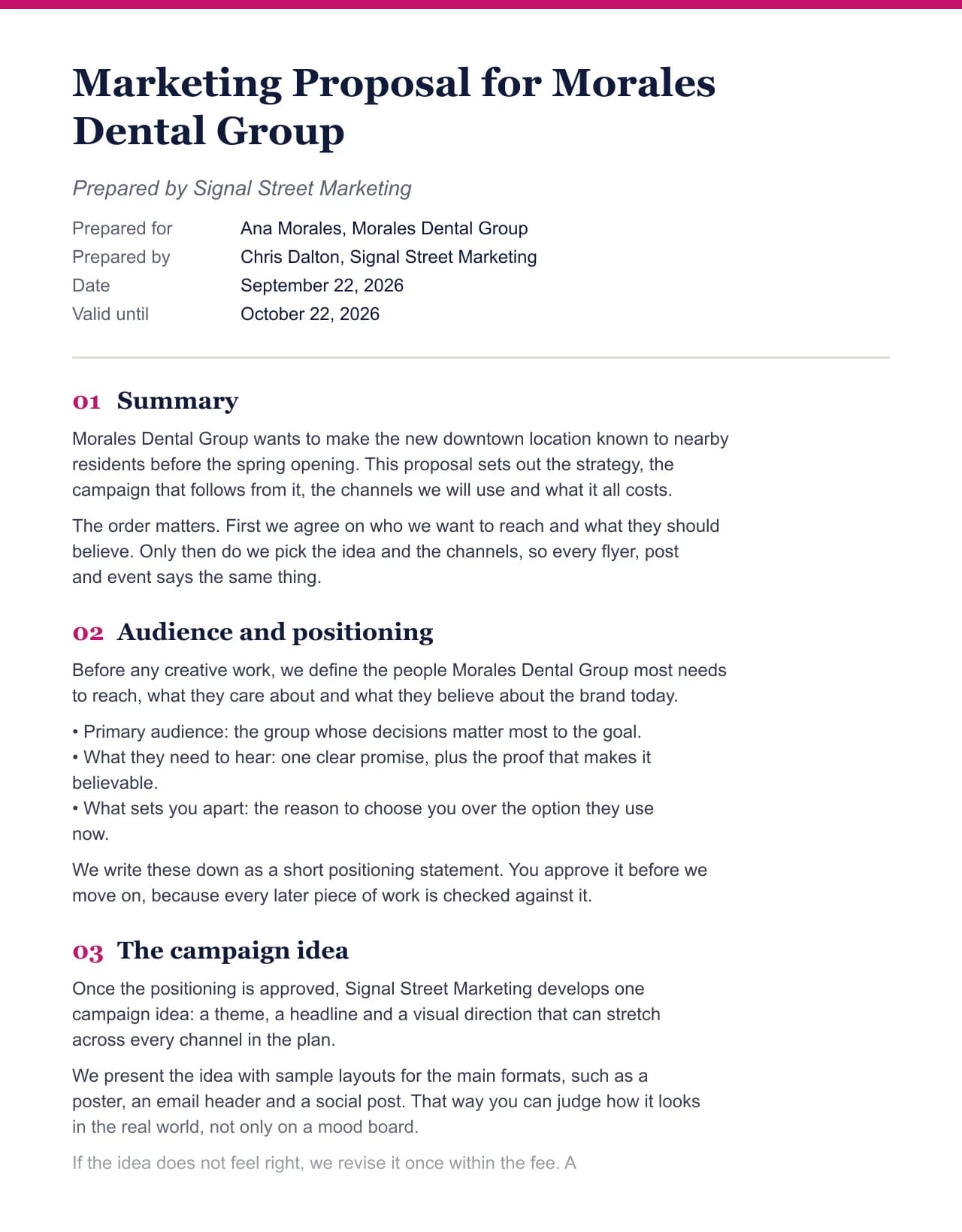
We ran a fictional business and client through this exact generator. Every number below comes from that run, including the size of the Word file the download button produces.
- Test input
- Signal Street Marketing (fictional) writing to Morales Dental Group, with the default deliverables and prices for this field
- Output
- Marketing Proposal, 12 sections
- Words
- 910
- Sections
- 12
- Price options
- 3
- Placeholders left
- 0
- Word file size
- 13 KB
- Generation time
- 1 ms
How we test: every page uses the same input, and we check each output by hand. More on the about page.
The full marketing proposal template, section by section
This is the text the generator starts from. It is written for a brand and campaign project that mixes offline and online channels, so cut the channel plan down if you only run one part of the mix.
Text in square brackets is yours to fill in. The tool above fills it for you, and the notes explain why each section is there.
Marketing Proposal for [Client company]
- Prepared for
- [Client name], [Client company]
- Prepared by
- [Your name], [Your business]
- Date
- [date]
- Valid until
- [date]
01Summary
Why this section: Owners and marketing managers often forward the proposal to a partner or a board. The summary has to carry the goal, the idea and the fee on its own, because that may be the only part the second reader sees.
[Client company] wants to [reach the client's goal]. This proposal sets out the strategy, the campaign that follows from it, the channels we will use and what it all costs.
The order matters. First we agree on who we want to reach and what they should believe. Only then do we pick the idea and the channels, so every flyer, post and event says the same thing.
02Audience and positioning
Why this section: Marketing money is wasted when it speaks to everyone. Naming the audience and the one thing they should remember shows the client you think about buyers, not just about outputs like ads and posts.
Before any creative work, we define the people [Client company] most needs to reach, what they care about and what they believe about the brand today.
- Primary audience: the group whose decisions matter most to the goal.
- What they need to hear: one clear promise, plus the proof that makes it believable.
- What sets you apart: the reason to choose you over the option they use now.
We write these down as a short positioning statement. You approve it before we move on, because every later piece of work is checked against it.
03The campaign idea
Why this section: Clients hire a marketer for ideas, yet an idea in a proposal must stay loose enough to change after research. So describe how the concept will be developed and tested instead of pitching finished ads for free.
Once the positioning is approved, [Your business] develops one campaign idea: a theme, a headline and a visual direction that can stretch across every channel in the plan.
We present the idea with sample layouts for the main formats, such as a poster, an email header and a social post. That way you can judge how it looks in the real world, not only on a mood board.
If the idea does not feel right, we revise it once within the fee. A completely new direction after approval counts as a change in scope.
04Channel plan
Why this section: A marketing proposal should show the whole mix, offline included. Local buyers still notice signs, events, direct mail and the local paper, and the client wants to see how each channel supports the others.
We choose channels for the audience, not by habit. A typical plan mixes owned, earned and paid channels, and each one has a clear job.
- Owned: your website, email list, store signage and social accounts carry the message every day.
- Earned: local press, partnerships and community events create word of mouth you cannot buy.
- Paid: print, direct mail, outdoor or online ads extend the reach where the owned channels stop.
The final plan lists each channel with its purpose, timing and share of the budget. Therefore you can see at a glance where the money goes and why.
05Brand and approvals
Why this section: Campaigns touch printers, venues, staff and partners, and each one can drift from the brand. A named approver and a simple sign off step keep the message consistent and stop late changes that cost money.
All materials follow the brand guidelines of [Client company]. If there are none yet, we note the logo, colors and fonts we use so the campaign stays consistent.
Each piece goes to one named approver before it goes to the printer, goes live or goes out by mail. We ask for one set of combined comments per round, because conflicting notes from several people slow everything down.
06Scope and deliverables
Why this section: A numbered list of what the client gets is the part they read twice. A clear list also protects you: anything not on it is extra work with an extra price.
[Your business] will deliver the following for [Client company]:
- Marketing review of your brand, audience and current channels
- Positioning statement and key messages
- One campaign concept with headline, visuals and a sample of each format
- Campaign plan across print, events, local press, email and social
- Launch calendar with a budget split by channel
- Wrap-up review with what worked and what to change next time
Anything not on this list is outside the scope of this proposal. If the project needs more, we will agree on it in writing before any extra work starts.
07Timeline
Why this section: Clients plan around your dates. So state the length, say when the clock starts and say what happens when feedback is late.
The work takes [timeline, for example 6 weeks] from the day this proposal is accepted and the first payment arrives.
The schedule assumes feedback within two business days at each review point. If materials or approvals arrive later, the dates move by the same number of days.
08Media and production costs
Why this section: Clients often mix up the agency fee with the money spent on printing, ad space and event costs. Separating the two in writing avoids a common billing dispute in marketing work.
Our fees cover strategy, creative and coordination. Printing, ad space, event venues, postage and similar costs are separate, and [Client company] pays them directly or we pass them through at cost.
The campaign plan shows a recommended budget for each channel. Nothing is booked or ordered until you approve that spend in writing.
09Fees
Why this section: Show the price in a table next to what it buys. Two or three options let the client choose a level instead of saying yes or no to a single number.
There are 3 options below, so [Client company] can choose the level that fits the budget and the goal.
| Option | What is included | Price |
|---|---|---|
| Strategy | Marketing review, positioning and key messages | [price] |
| Strategy and campaign | Everything in Strategy plus the campaign concept and plan | [price] |
| Strategy, campaign and launch | Everything above plus launch coordination and the wrap-up review | [price] |
Payment terms: [payment terms, for example 50% to start and 50% on delivery].
All prices are in USD.
10How we will measure it
Why this section: Offline marketing is hard to measure, so clients worry they will never know what worked. Agreeing on signals before launch, such as tracked codes and simple customer questions, gives the review something real to discuss.
Before launch we agree on a small set of signals tied to the goal: [reach the client's goal]. Examples are visits, sign ups, inquiries, coupon codes, event attendance and how new customers say they heard about you.
We cannot promise specific results, since the market, timing and your offer all play a part. What we do promise is an honest wrap-up review with the numbers we collected and a clear view of what to repeat.
11Terms
Why this section: Marketing work produces creative assets the client will reuse for years. The terms should say who owns them, how extra requests are handled and what happens if plans change mid campaign.
- Ownership: after full payment, [Client company] owns the final campaign materials. Licensed fonts, stock photos and music stay under their own licenses.
- Changes: requests outside the scope get a written quote and start only after approval.
- Portfolio: [Your business] may show the finished campaign in its portfolio unless you ask us not to.
- Cancellation: either side can end the project with 14 days written notice, and we invoice the work done up to that date.
12Next steps
Why this section: End with one clear action and a signature block. An expiry date gives the client a reason to decide and protects you from old prices.
To go ahead, sign below and reply to this proposal. We then send the first invoice and book the kickoff call.
This proposal is valid until [date] (30 days).
| [Your business] | [Client company] | |
|---|---|---|
| Name | [Your name] | [Client name] |
| Signature | ||
| Date |
What a marketing proposal template has to cover
A marketing proposal sells a way of thinking about the client's buyers. Ads, flyers and posts come later. So a good marketing proposal template starts with the audience and the position you want to hold in their minds, and only then moves to the campaign idea and the channels.
This template is built for the broad version of the job. That means brand work, one campaign idea and a mix that can include print, events, local press, direct mail, email and social. If your client mainly wants paid search, paid social and email run month by month, the digital marketing proposal template is the closer fit.
Two sections set this template apart from a generic business proposal. First, the brand and approvals section names one approver, because campaigns stall when five people send notes. Second, a separate costs section splits your fee from the money spent on printing and ad space.
How to price a marketing proposal
Many marketers price strategy and campaign work as a fixed project fee, then switch to a monthly retainer for ongoing execution. A fixed fee suits this template, because the deliverables run from the first review to a wrap-up meeting. However, keep the media spend out of that fee.
Stacked options work well here. For example, offer strategy alone, then strategy plus the campaign, then the full launch. The client can start with the thinking and add the execution when the budget allows. Each option in the table says what it includes, so nobody has to guess.
Also state how you handle outside costs. Some agencies pass printing and ad space through at cost, while others add a handling fee. Either is fine, as long as the proposal says which one you use before the first invoice arrives.
What clients look for in a marketing proposal
Clients want proof that you understand their customers, not a list of tactics. That is why the audience section comes second and includes a space for the notes from your first meeting. When the client sees their own words there, the rest of the plan feels built for them.
They also want to know how they will judge the result. Instead of promising numbers, the measurement section agrees on signals before launch, such as coupon codes, inquiries or how new customers heard about the business. As a result, the wrap-up review can compare real data with the plan.
When this marketing proposal template is not the right fit
A large company that sends a formal request for proposal will expect its own format, credentials and case studies. In that case, answer their questions in their order and use this marketing proposal template only as a checklist. Likewise, a single task such as a new flyer needs a one page quote, not twelve sections.
The template also assumes one campaign. For a year of ongoing marketing, keep the strategy sections and replace the campaign idea with a quarterly plan. And if the work is mostly social media posting, the social media proposal template has the calendar, cadence and community sections you need.
Marketing proposal vs digital marketing proposal
| Part of the proposal | Marketing proposal (this template) |
|---|---|
| Main question | Who should we reach, what should they believe, and which idea gets it across |
| Channels | A mix of owned, earned and paid, offline included: print, events, press, mail, email, social |
| Creative | One campaign idea with sample layouts in the main formats |
| Budget | Fee for strategy and creative, with printing and ad space listed separately |
| Measurement | Signals agreed before launch and a wrap-up review |
| Contract shape | Usually a fixed project fee, sometimes followed by a retainer |
| Closest alternative | The digital marketing template, for ongoing paid search, paid social and email |
Marketing proposal template FAQ
What should a marketing proposal include?
It should include a summary, the audience and positioning, the campaign idea, a channel plan, brand and approval rules, scope, timeline, media and production costs, your fees, how you will measure results, terms and a way to accept. The template on this page has all twelve.
How do I write a marketing proposal?
Start from the client's goal and audience, then explain the idea and the channels that carry it. Close with a clear scope, a price table and a signature block. The form on this page writes that structure for you from a few lines of input.
How much should I charge for a marketing proposal?
Price the strategy and creative work as a fixed fee based on the hours you expect, and list media, printing and event costs separately. Two or three stacked options let the client choose how much to buy now.
What is the difference between a marketing plan and a marketing proposal?
A marketing plan describes what a business will do. A marketing proposal is your offer to create or run that plan for a client, with a scope, a price and terms. This template produces the proposal, and the plan is one of its deliverables.
Should a marketing proposal promise results?
No. The outcome depends on the market, the offer and timing, which you do not control. Promise the work, the process and an honest review of the numbers instead.
Is this marketing proposal template free?
Yes. Reading the template, filling it in, editing it and downloading the Word file are free with no account. Only the AI step that tailors a draft to a pasted client brief uses credits.