Social media proposal template
A social media proposal template spells out which platforms you will run, what you will post and how often, who answers comments, how the client approves content and what the monthly fee covers. The one below has twelve sections for a social media management retainer. Read it, or fill it in free.
By The Clinchdraft team (Product and testing). Last updated .
How to fill in a social media proposal template, step by step
- Check the client's current accounts and note which platforms their customers actually use.
- Write the goal as a business result, such as more reservations or store visits, rather than more followers.
- Put the exact monthly volume in the deliverables, for example the number of feed posts and stories per platform.
- Set your response hours for comments and messages, since the community section refers to them.
- Add one to three monthly options and write per month in each note, so nobody reads them as one time fees.
- Generate the draft, read the approvals section and change the deadlines to the ones you can keep.
Generating a proposal is free and needs no account. Tailoring it to a client brief uses a credit, so see the pricing page for packs and plans, or read how we test the templates.
Social media proposal template tested with a real input
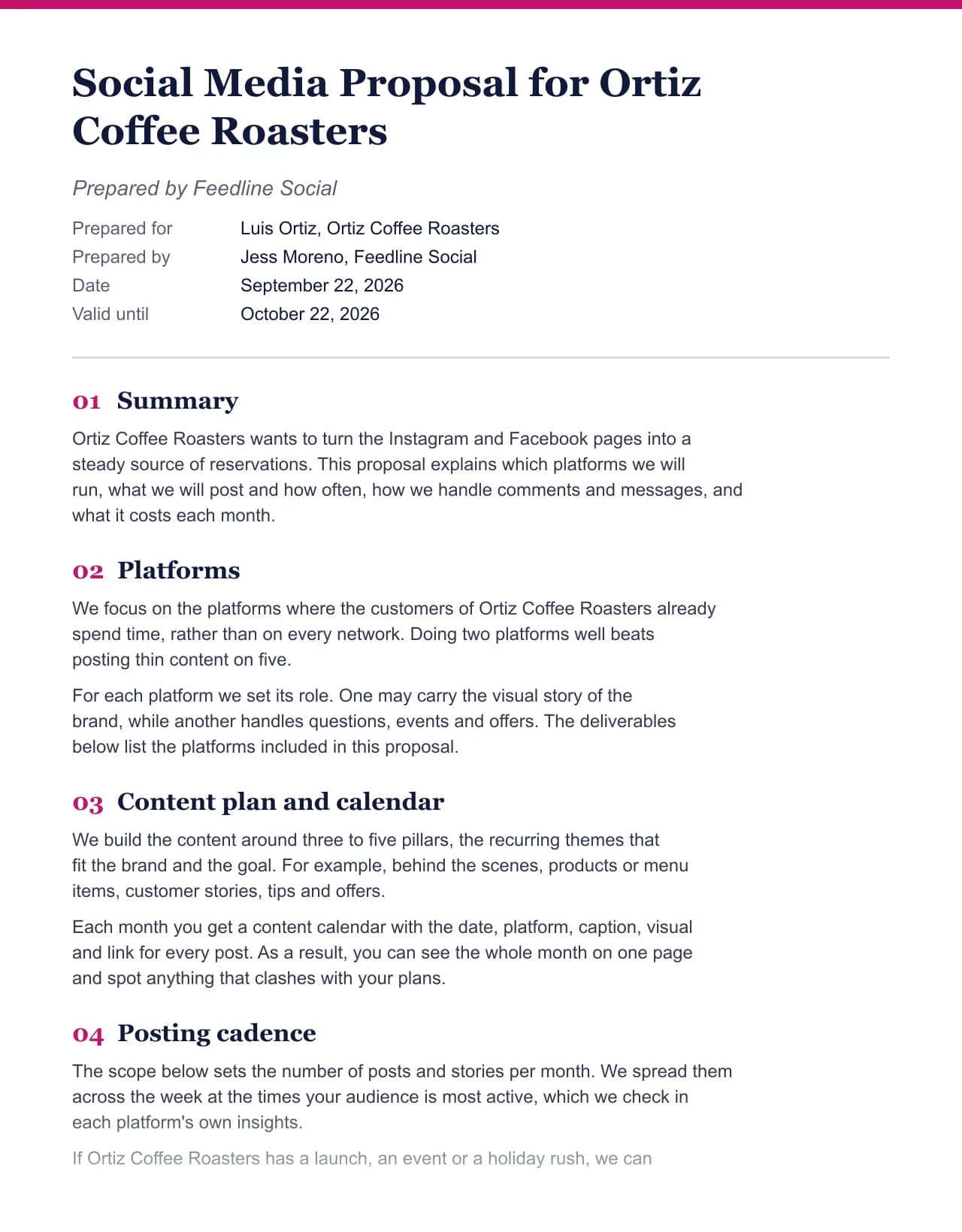
We ran a fictional business and client through this exact generator. Every number below comes from that run, including the size of the Word file the download button produces.
- Test input
- Feedline Social (fictional) writing to Ortiz Coffee Roasters, with the default deliverables and prices for this field
- Output
- Social Media Proposal, 12 sections
- Words
- 798
- Sections
- 12
- Price options
- 3
- Placeholders left
- 0
- Word file size
- 12 KB
- Generation time
- 1 ms
How we test: every page uses the same input, and we check each output by hand. More on the about page.
The full social media proposal template, section by section
This is the text the generator starts from. It is written for a monthly social media management retainer, so shorten the community and approvals sections if you only deliver a content calendar.
Text in square brackets is yours to fill in. The tool above fills it for you, and the notes explain why each section is there.
Social Media Proposal for [Client company]
- Prepared for
- [Client name], [Client company]
- Prepared by
- [Your name], [Your business]
- Date
- [date]
- Valid until
- [date]
01Summary
Why this section: Social media looks easy from the outside, so clients wonder what they are paying for. The summary should connect the monthly work to a business goal, not to likes, from the first paragraph.
[Client company] wants to [reach the client's goal]. This proposal explains which platforms we will run, what we will post and how often, how we handle comments and messages, and what it costs each month.
02Platforms
Why this section: Clients often ask to be on every network at once. Naming the platforms you will run, and why those, sets a scope the budget can support and explains why the rest can wait.
We focus on the platforms where the customers of [Client company] already spend time, rather than on every network. Doing two platforms well beats posting thin content on five.
For each platform we set its role. One may carry the visual story of the brand, while another handles questions, events and offers. The deliverables below list the platforms included in this proposal.
03Content plan and calendar
Why this section: The content calendar is the product the client actually sees each month. Explaining pillars and the calendar format up front shows there is a plan behind every post instead of last minute ideas.
We build the content around three to five pillars, the recurring themes that fit the brand and the goal. For example, behind the scenes, products or menu items, customer stories, tips and offers.
Each month you get a content calendar with the date, platform, caption, visual and link for every post. As a result, you can see the whole month on one page and spot anything that clashes with your plans.
04Posting cadence
Why this section: Posting frequency is the number clients remember and compare between proposals. Put it in writing, together with what happens around holidays and slow weeks, so nobody counts posts at the end of the month.
The scope below sets the number of posts and stories per month. We spread them across the week at the times your audience is most active, which we check in each platform's own insights.
If [Client company] has a launch, an event or a holiday rush, we can shift posts within the month. We quote extra posts beyond the monthly number separately.
05Community management
Why this section: Replies to comments and messages are part of the brand's customer service. The client needs to know who answers, when, and what gets passed back to them, especially complaints and anything legal or medical.
- Response hours: we check comments and messages during the hours set in the scope, and reply within the same business day.
- Tone: we answer in the brand voice agreed in the first month, using a short list of approved answers for common questions.
- Escalation: complaints, refund requests, press inquiries and anything legal go straight to the contact at [Client company], and we do not answer them on your behalf.
- Moderation: we hide spam and abusive comments according to a policy you approve.
06Approvals
Why this section: Missed approvals are a common reason social calendars slip. A fixed deadline, one approver and a rule for what happens when nobody replies keep the feed running without awkward chasing.
We send the calendar for the next month at least one week before it starts. One named person at [Client company] approves it or sends back combined comments within three business days.
If we have not heard back by then, we post the approved evergreen content and hold anything time sensitive. That way the feed never goes quiet while approvals wait.
07Scope and deliverables
Why this section: A numbered list of what the client gets is the part they read twice. A clear list also protects you: anything not on it is extra work with an extra price.
[Your business] will deliver the following for [Client company]:
- Account review and content pillars for Instagram and Facebook
- Monthly content calendar sent for approval a week ahead
- 12 feed posts and 8 stories per month, written and designed
- Community management on weekdays during business hours
- One on-site photo session per quarter
- Monthly performance report
Anything not on this list is outside the scope of this proposal. If the project needs more, we will agree on it in writing before any extra work starts.
08Reporting
Why this section: Without a report, social media feels like money spent on posts nobody sees. A monthly report tied to the goal, with clicks and inquiries next to reach and engagement, shows what the retainer delivers.
Each month [Client company] receives a short report built from the platforms' own analytics. It covers reach, engagement, follower change, link clicks and, where you track them, inquiries or bookings.
We do not promise follower numbers or viral posts, because platform algorithms change often and nobody controls them. Instead, each report ends with what we learned and what we will change next month.
09Timeline and onboarding
Why this section: Clients plan around your dates. So state the length, say when the clock starts and say what happens when feedback is late.
The work takes [timeline, for example 6 weeks] from the day this proposal is accepted and the first payment arrives.
The schedule assumes feedback within two business days at each review point. If materials or approvals arrive later, the dates move by the same number of days.
10Monthly fee
Why this section: Show the price in a table next to what it buys. Two or three options let the client choose a level instead of saying yes or no to a single number.
There are 3 options below, so [Client company] can choose the level that fits the budget and the goal.
| Option | What is included | Price |
|---|---|---|
| Starter | Per month: one platform, calendar, posts and monthly report | [price] |
| Growth | Per month: two platforms, posts, stories and community management | [price] |
| Full service | Per month: everything in Growth plus quarterly photo sessions | [price] |
Payment terms: [payment terms, for example 50% to start and 50% on delivery].
All prices are in USD.
11Terms
Why this section: Social media work runs on the client's accounts, so the terms must say who owns them and what happens to logins and content when the contract ends. Paid ads also need a line of their own.
- Accounts: [Client company] owns every social account and keeps full admin access. We work through team access and hand back all logins when the work ends.
- Content: after payment, [Client company] owns the posts and designs we create. Stock images and music stay under their own licenses.
- Ad spend: paid promotion is optional, billed by the platform to your card, and separate from our fee.
- Disclosure: sponsored posts and influencer partnerships follow the FTC rules on disclosing paid relationships.
- Notice: after the first term, either side can end the work with 30 days written notice.
12Next steps
Why this section: End with one clear action and a signature block. An expiry date gives the client a reason to decide and protects you from old prices.
To go ahead, sign below and reply to this proposal. We then send the first invoice and book the kickoff call.
This proposal is valid until [date] (30 days).
| [Your business] | [Client company] | |
|---|---|---|
| Name | [Your name] | [Client name] |
| Signature | ||
| Date |
What a social media proposal template needs that others do not
Social media management is ongoing work on accounts the client owns. That creates questions a project proposal never has to answer. Who posts, how often, who replies to an angry comment at nine at night, and who keeps the passwords when the contract ends?
This social media proposal template answers each of those in its own section. First, the cadence section fixes the monthly volume. Next, the community section sets response hours and lists what goes back to the client, such as complaints and press requests. Finally, the terms confirm that the client owns every account and keeps admin access.
The approvals section matters most in practice. A calendar that waits two weeks for a reply leaves the feed empty. So the template sets a deadline, names one approver and says what happens when nobody answers.
How to price social media management
Many managers sell this work as a monthly retainer with a short minimum term. Price it from the volume in the scope: the number of platforms, posts and stories, the hours of community management and any photo or video shoots.
Tiered options fit this field well. For instance, a starter plan for one platform, a growth plan for two platforms with community management, and a full service plan that adds content shoots. Each option should state its volume, so the client compares plans by what they get.
Keep ad spend out of your fee. The template says that paid promotion is billed by the platform to the client's own card. That protects you from fronting ad costs and keeps the client in control of the budget.
What clients look for in a social media proposal
Clients want to see that you understand their customers and their voice. A few sample post ideas in the details box, written for their brand, often say more than a long agency profile. Then the content pillars and the calendar format show that those ideas will keep coming every month.
They also want honest reporting. The template reports reach, engagement, follower change and link clicks from the platforms' own analytics. However, it does not promise follower numbers or viral posts, because algorithms change often and nobody controls them.
When this social media proposal template is not the right fit
An influencer campaign or a creator partnership is a different deal, with usage rights, exclusivity and FTC disclosure at the center. Likewise, a large paid social budget is closer to performance marketing, and the digital marketing proposal template covers that better.
The template also assumes ongoing work. For a one time account setup or a single launch campaign, keep the platforms and content sections, then replace the monthly fee with a project price.
Sections in the social media proposal template
| Section | What the client learns |
|---|---|
| Platforms | Which networks you will run and the role of each one |
| Content plan and calendar | The content pillars and what each monthly calendar shows |
| Posting cadence | How many posts and stories per month, and how busy weeks are handled |
| Community management | Response hours, tone, moderation and what gets escalated |
| Approvals | The calendar deadline, the approver and what happens without a reply |
| Reporting | Monthly reach, engagement, clicks and inquiries, with next steps |
| Terms | Account ownership, content rights, ad spend, disclosure and notice |
Social media proposal template FAQ
What should a social media proposal include?
It should include the platforms, a content plan and calendar, posting cadence, community management, an approval process, reporting, scope, timeline, monthly fees and terms on account ownership. This social media proposal template has all of these sections.
How do I write a social media management proposal?
Look at the client's accounts first, then tie the work to a business goal. Set out the platforms, the monthly volume, who answers comments and how approvals work, and close with the monthly fee. The form on this page drafts that for you.
How much should I charge for social media management?
Many managers charge a monthly retainer based on platforms, post volume and community management hours. Start from the hours the scope takes you and add content shoots or ad management as separate options.
Should the client pay for ads through me?
It is usually simpler if the platform bills the client's own card for ad spend and you bill only your fee. The terms in this template are set up that way.
Who owns the social media accounts?
The client should own every account and keep full admin access, with you working through team access. The template states this and says you hand back all logins when the work ends.
Is this social media proposal template free?
Yes. You can read it, fill it in, edit it and download the Word file with no account. Only the AI step that tailors a draft to a pasted client brief uses credits.