Graphic design proposal template
A graphic design proposal template records the creative brief, how many concepts and revision rounds you include, which files the client receives, who owns the design and what happens if the project is canceled. The one below has ten sections for logo, brand and print work. Read it here or fill it in for free.
By The Clinchdraft team (Product and testing). Last updated .
How to fill in a graphic design proposal template, step by step
- Write down the brief from your first call in the details box: audience, message, must haves and where the design will appear.
- Put the number of concepts and revision rounds into the deliverables, for example three concepts and two rounds.
- Name the final file formats, since printers and web developers ask for different ones.
- Add one to three fee options that build from a single piece to a full brand kit.
- Generate the draft, then set the kill fee and the payment terms to match your deposit.
- Download the Word file, add a few relevant portfolio images and send it the same week.
Generating a proposal is free and needs no account. Tailoring it to a client brief uses a credit, so see the pricing page for packs and plans, or read how we test the templates.
Graphic design proposal template tested with a real input
We ran a fictional business and client through this exact generator. Every number below comes from that run, including the size of the Word file the download button produces.
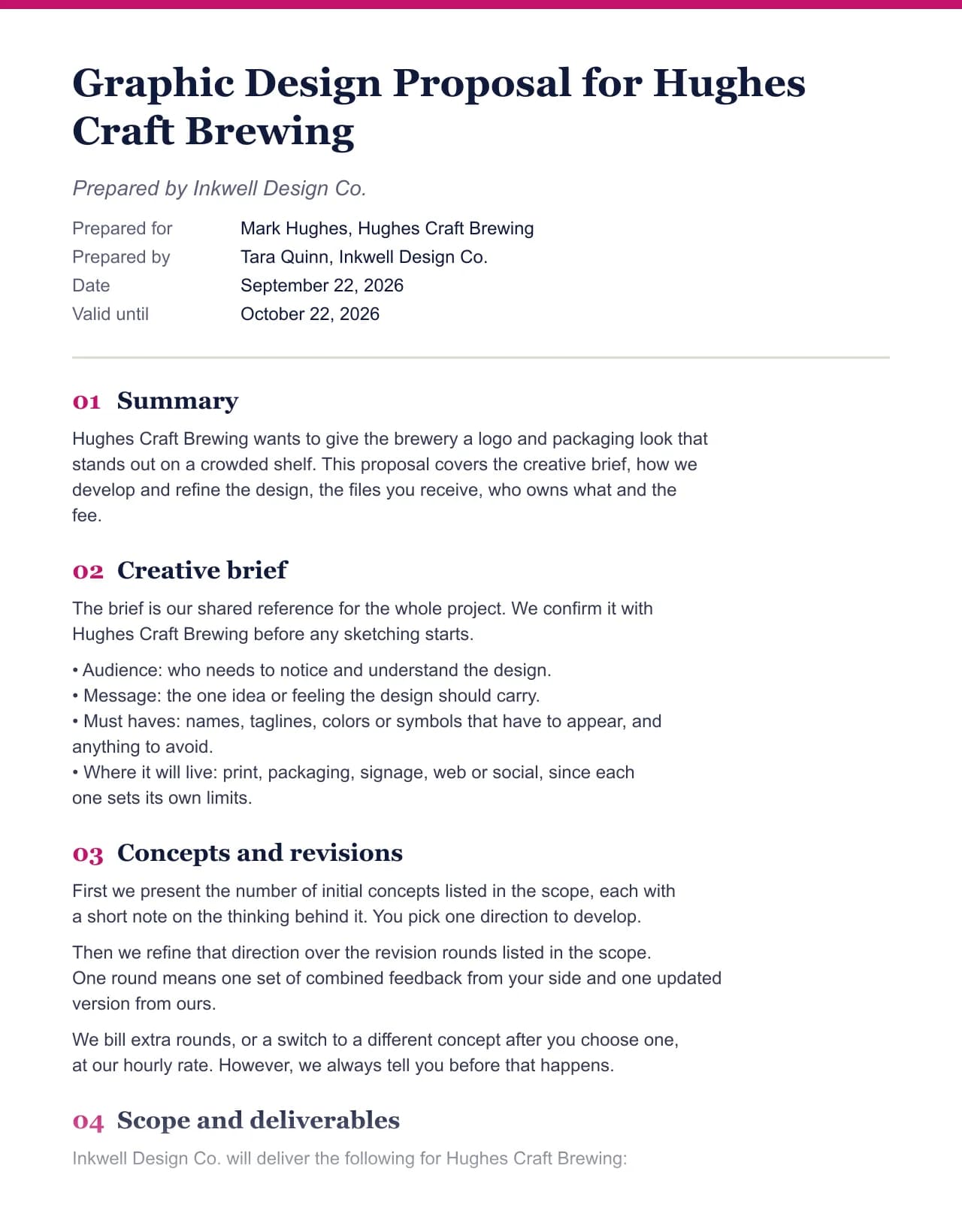
- Test input
- Inkwell Design Co. (fictional) writing to Hughes Craft Brewing, with the default deliverables and prices for this field
- Output
- Graphic Design Proposal, 10 sections
- Words
- 731
- Sections
- 10
- Price options
- 3
- Placeholders left
- 0
- Word file size
- 12 KB
- Generation time
- 1 ms
How we test: every page uses the same input, and we check each output by hand. More on the about page.
The full graphic design proposal template, section by section
This is the text the generator starts from. It is written for a logo and packaging project, so swap the file list and the brief questions for web graphics, illustration or a single print piece.
Text in square brackets is yours to fill in. The tool above fills it for you, and the notes explain why each section is there.
Graphic Design Proposal for [Client company]
- Prepared for
- [Client name], [Client company]
- Prepared by
- [Your name], [Your business]
- Date
- [date]
- Valid until
- [date]
01Summary
Why this section: Design clients often buy on feeling, but someone still has to approve the spend. A short summary that ties the design to a business goal gives that person a reason beyond taste.
[Client company] wants to [reach the client's goal]. This proposal covers the creative brief, how we develop and refine the design, the files you receive, who owns what and the fee.
02Creative brief
Why this section: Many design disputes start with a brief nobody wrote down. Recording the audience, message, must have elements and where the design will appear gives both sides one page to check every concept against.
The brief is our shared reference for the whole project. We confirm it with [Client company] before any sketching starts.
- Audience: who needs to notice and understand the design.
- Message: the one idea or feeling the design should carry.
- Must haves: names, taglines, colors or symbols that have to appear, and anything to avoid.
- Where it will live: print, packaging, signage, web or social, since each one sets its own limits.
03Concepts and revisions
Why this section: Unlimited revisions quietly turn a fixed fee into an hourly job with no end. Naming the number of concepts and revision rounds, and what counts as a round, keeps the project on budget and on time.
First we present the number of initial concepts listed in the scope, each with a short note on the thinking behind it. You pick one direction to develop.
Then we refine that direction over the revision rounds listed in the scope. One round means one set of combined feedback from your side and one updated version from ours.
We bill extra rounds, or a switch to a different concept after you choose one, at our hourly rate. However, we always tell you before that happens.
04Scope and deliverables
Why this section: A numbered list of what the client gets is the part they read twice. A clear list also protects you: anything not on it is extra work with an extra price.
[Your business] will deliver the following for [Client company]:
- Three initial logo concepts based on the approved creative brief
- Two rounds of revisions on the chosen concept
- Final logo in full color, one color and reversed versions
- Label design for two can sizes, print ready
- One page brand guide with colors, fonts and logo spacing
- Final files in AI, EPS, SVG, PDF and PNG
Anything not on this list is outside the scope of this proposal. If the project needs more, we will agree on it in writing before any extra work starts.
05Final files and formats
Why this section: Clients rarely know which file a printer or a web developer will ask for. Listing the formats, color modes and what happens with fonts saves a frantic email the day the design goes to print.
When the final payment arrives, [Client company] receives the approved designs in the formats that fit each use:
- Vector files (AI, EPS, SVG) that scale to any size, for print and signage.
- Print ready PDF files in CMYK, with bleed where the printer needs it.
- PNG and JPG files in RGB for web, email and social media.
Fonts are not ours to hand over. If the design uses a paid typeface, we name it, and you buy your own license to edit the files.
06Usage rights and ownership
Why this section: Under US copyright law, a freelance designer usually owns the work until a signed document transfers the rights. Clients need to see exactly what they will own, when, and which parts stay licensed from others.
- Transfer: once the final invoice is paid, [Your business] transfers the copyright in the final approved design to [Client company].
- Before payment: until then, you may review the work but not use it in public.
- Unused concepts: concepts you did not choose remain ours, and we will not sell them to a competitor.
- Third party parts: stock images, illustrations and fonts stay under their own licenses.
- Portfolio: [Your business] may show the finished work in its portfolio unless you ask us in writing not to.
07Timeline
Why this section: Clients plan around your dates. So state the length, say when the clock starts and say what happens when feedback is late.
The work takes [timeline, for example 6 weeks] from the day this proposal is accepted and the first payment arrives.
The schedule assumes feedback within two business days at each review point. If materials or approvals arrive later, the dates move by the same number of days.
08Design fee
Why this section: Show the price in a table next to what it buys. Two or three options let the client choose a level instead of saying yes or no to a single number.
There are 3 options below, so [Client company] can choose the level that fits the budget and the goal.
| Option | What is included | Price |
|---|---|---|
| Logo | Concepts, two revision rounds and the final logo files | [price] |
| Logo and labels | Everything in Logo plus label design for two can sizes | [price] |
| Brand kit | Everything above plus the brand guide and social media templates | [price] |
Payment terms: [payment terms, for example 50% to start and 50% on delivery].
All prices are in USD.
09Terms
Why this section: Design projects get paused or dropped when plans change on the client's side. A kill fee and clear payment milestones make sure the hours already spent on concepts still get paid.
- Deposit: work starts once the first payment arrives, as set in the payment terms above.
- Kill fee: if [Client company] cancels the project, we keep the deposit as a kill fee. If we have already presented concepts, the invoice also covers the work done up to that stage.
- Pauses: if we do not hear back for 30 days, we treat the project as paused and restart it on the next free slot in our schedule.
- Printing and production: we quote print runs, materials and delivery separately from the design fee.
10Next steps
Why this section: End with one clear action and a signature block. An expiry date gives the client a reason to decide and protects you from old prices.
To go ahead, sign below and reply to this proposal. We then send the first invoice and book the kickoff call.
This proposal is valid until [date] (30 days).
| [Your business] | [Client company] | |
|---|---|---|
| Name | [Your name] | [Client name] |
| Signature | ||
| Date |
What makes a graphic design proposal template different
Design is sold before the client can see it. That makes two questions central: how the design will take shape, and when it counts as finished. So this graphic design proposal template spends most of its words on the brief, the concepts and the revision rounds.
The brief comes first because it settles arguments later. When a client says a concept feels wrong, you can both check it against the audience, message and must haves you agreed on. As a result, feedback turns from taste into a question of fit.
The template also covers two things a general service proposal skips. First, it lists the final file formats and color modes, so the files work at the printer. Second, it spells out usage rights, including fonts and stock images that the client has to license on their own.
Revision rounds, usage rights and the kill fee
Unlimited revisions are a quick way to lose money on a fixed fee. The template names the number of rounds and defines one round as one set of combined feedback and one updated version. After that, you bill extra rounds hourly, and the client hears about it before it happens.
Ownership matters just as much. Under US copyright law, a freelancer usually keeps the copyright unless a signed document transfers it or the work qualifies as a work made for hire. The template transfers rights in the final design on full payment, and it keeps unused concepts with the designer.
Finally, the kill fee protects the hours spent on concepts if the client cancels. In this template, the deposit becomes the kill fee, and any work after the first presentation is billed for the stage reached. Adjust the wording to match what your deposit covers.
How to price a graphic design proposal
Many designers quote a flat project fee, because clients find it easier to approve than an hourly estimate. The fee holds only as long as the scope does, which is why this graphic design proposal template ties it to a set number of concepts and rounds.
Stacked options suit design well. For instance, a logo alone, then a logo with packaging, then a brand kit with a guide and social templates. The client can start small and come back for the rest. Also keep printing, materials and delivery out of the design fee, and quote them separately.
When this graphic design proposal template is not the right fit
Ongoing design support, such as a set number of social graphics every month, fits a retainer better than a project proposal. In that case, keep the rights and file sections and replace the concepts section with a monthly request process.
Likewise, a full website involves development, hosting and content, which this template does not cover. Use the web design proposal template for that, and keep this one for logos, brand identity, packaging and print.
Sections in the graphic design proposal template
| Section | What it settles |
|---|---|
| Creative brief | Audience, message, must haves and where the design will appear |
| Concepts and revisions | How many concepts, how many rounds and what counts as one round |
| Scope and deliverables | Every design piece included, and that anything else is extra |
| Final files and formats | Vector, print ready PDF and web files, color modes and fonts |
| Usage rights and ownership | When copyright transfers, unused concepts, third party licenses, portfolio use |
| Timeline and design fee | How long it takes and one to three priced options |
| Terms | Deposit, kill fee, paused projects and separate printing costs |
Graphic design proposal template FAQ
What should a graphic design proposal include?
It should include a summary, the creative brief, the number of concepts and revision rounds, the scope, the final file formats, usage rights, a timeline, fees, terms with a kill fee and a signature block. This graphic design proposal template has all ten sections.
How do I write a graphic design proposal?
Start by writing down the brief from your first conversation, then explain your process from concepts to final files. Close with rights, a clear price and the terms for cancellation. The form on this page builds that draft for you.
How many revisions should a design proposal include?
Pick a number you can deliver within the fee and write it down, along with what counts as one round. Extra rounds should carry an hourly rate that the client sees before they ask for them.
Who owns the design after the project?
Whoever the contract says. A freelancer usually owns the copyright until a signed document transfers it, so the proposal should state when ownership passes to the client and what stays licensed from others.
What is a kill fee in graphic design?
A kill fee is what the client pays if they cancel the project after work has started. It covers the time already spent, often through the deposit plus the work done up to the stage reached.
Is this graphic design proposal template free?
Yes. You can read, fill in, edit and download it as a Word file with no account. Only the AI step that tailors a draft to a pasted client brief uses credits.