Catering proposal template
A catering proposal template gives a client everything they compare between caterers: event details, menu options, dietary and allergy handling, staff and rentals, a tasting, key dates, pricing and headcount terms. Read the full template below, or fill in the short form and get a finished catering proposal to edit and download, free.
By The Clinchdraft team (Product and testing). Last updated .
How to fill in a catering proposal template, step by step
- Ask for the date, venue, estimated guest count and service style before you write anything.
- Write the host's goal as a verb phrase, such as serve a seated dinner that suits every guest.
- List what you provide, from the tasting to cleanup, one line each, so the client sees what the price covers.
- Add one to three price options tied to a service style, for example buffet, plated dinner and plated dinner with bar.
- Press Generate, fill the bracketed menu lines and set your final headcount deadline.
- Download the Word file or save it as a PDF, and send it with a date to book the tasting.
Generating a proposal is free and needs no account. Tailoring it to a client brief uses a credit, so see the pricing page for packs and plans, or read how we test the templates.
Catering proposal template tested with a real input
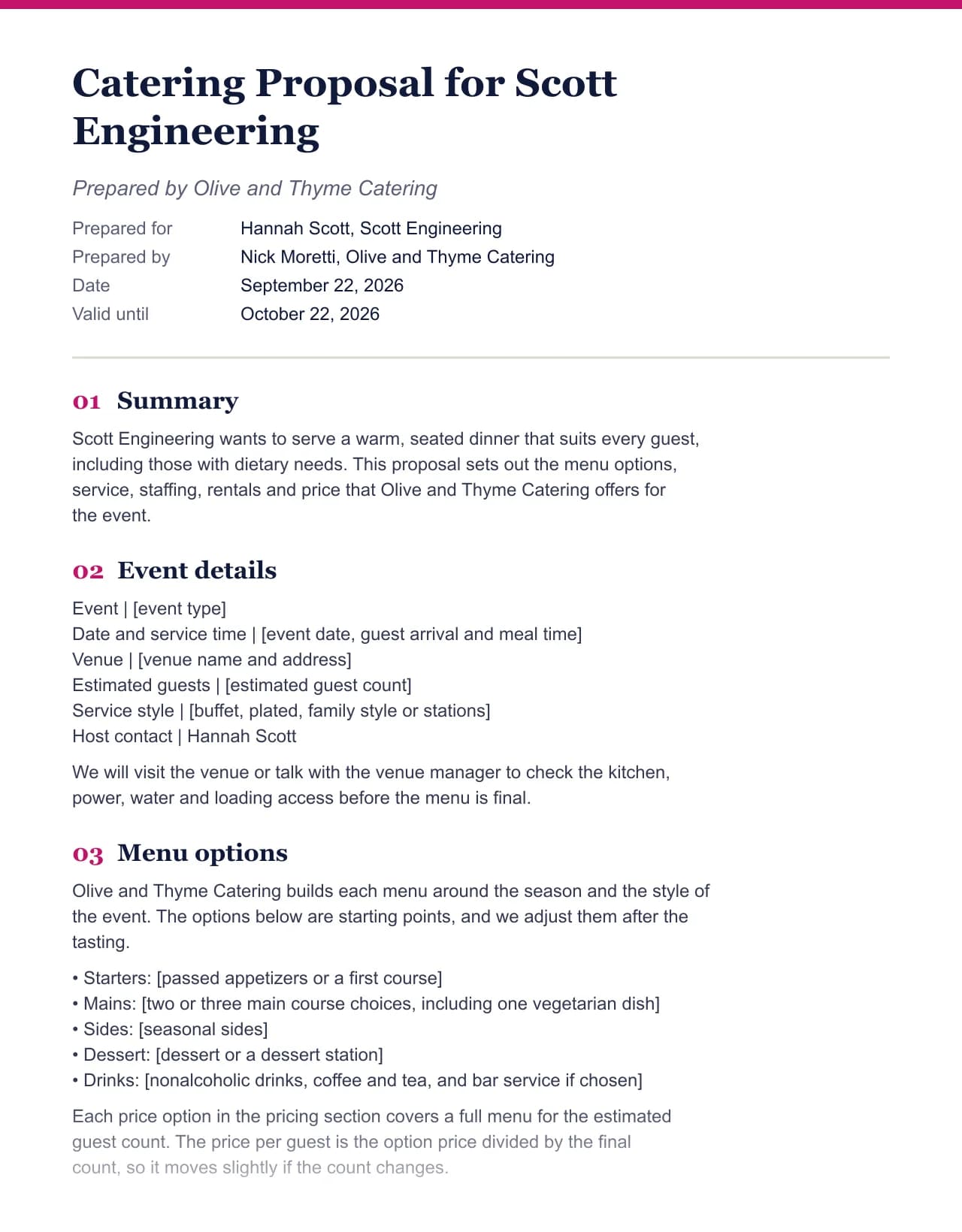
We ran a fictional business and client through this exact generator. Every number below comes from that run, including the size of the Word file the download button produces.
- Test input
- Olive and Thyme Catering (fictional) writing to Scott Engineering, with the default deliverables and prices for this field
- Output
- Catering Proposal, 11 sections
- Words
- 783
- Sections
- 11
- Price options
- 3
- Placeholders left
- 14
- Word file size
- 12 KB
- Generation time
- 1 ms
How we test: every page uses the same input, and we check each output by hand. More on the about page.
The full catering proposal template, section by section
This is the exact text the generator starts from. It fits a wedding, a company dinner or a private party, so trim the rentals for a drop off order and add stations for a large reception.
Text in square brackets is yours to fill in. The tool above fills it for you, and the notes explain why each section is there.
Catering Proposal for [Client company]
- Prepared for
- [Client name], [Client company]
- Prepared by
- [Your name], [Your business]
- Date
- [date]
- Valid until
- [date]
01Summary
Why this section: A catering client usually reads several quotes in one evening. A short opening that names their event goal and the service style helps your proposal stand out before they reach the menu.
[Client company] wants to [reach the client's goal]. This proposal sets out the menu options, service, staffing, rentals and price that [Your business] offers for the event.
02Event details
Why this section: The date, guest count, venue kitchen and service time decide how many cooks and servers the caterer needs. Putting them in a table lets the client correct a detail before it changes the price.
| Item | Details |
|---|---|
| Event | [event type] |
| Date and service time | [event date, guest arrival and meal time] |
| Venue | [venue name and address] |
| Estimated guests | [estimated guest count] |
| Service style | [buffet, plated, family style or stations] |
| Host contact | [Client name] |
We will visit the venue or talk with the venue manager to check the kitchen, power, water and loading access before the menu is final.
03Menu options
Why this section: The menu is the part a catering client talks about with the other hosts. Describe courses and choices in plain words, and tie each price option to a menu so the client can compare them quickly.
[Your business] builds each menu around the season and the style of the event. The options below are starting points, and we adjust them after the tasting.
- Starters: [passed appetizers or a first course]
- Mains: [two or three main course choices, including one vegetarian dish]
- Sides: [seasonal sides]
- Dessert: [dessert or a dessert station]
- Drinks: [nonalcoholic drinks, coffee and tea, and bar service if chosen]
Each price option in the pricing section covers a full menu for the estimated guest count. The price per guest is the option price divided by the final count, so it moves slightly if the count changes.
04Dietary needs and allergies
Why this section: Guests with allergies are the biggest risk at any catered event. Clients want to see that you ask about them early, label food clearly and keep separate plates, because they will be the ones facing the guest if something goes wrong.
- We ask for the number of vegetarian, vegan, gluten free and other special meals with the final headcount.
- Please tell us about any food allergy as soon as you know it. We then plan a separate plate and mark it with the guest's name or table.
- Buffet and station dishes carry labels that list the main allergens.
- Our kitchen handles common allergens such as nuts, dairy, gluten and shellfish, so we cannot promise a kitchen free of any single allergen. We will explain how we reduce cross contact for each plate.
05Staff and rentals
Why this section: Staff and rentals are where two catering quotes with the same menu differ most. Listing who works the event and which items you bring shows the client what the price really covers.
[Your business] staffs the event based on the final guest count and the service style. A lead captain runs the service and is the contact for the host and venue on the day.
- Staff: [number of servers, bartenders and kitchen staff], plus the lead captain.
- Rentals: [tables, chairs, linens, plates, glassware and flatware, as needed].
- Setup: we arrive [hours before service] to set up and stay until the catering area is clean.
- Leftovers: where food safety rules allow, we can pack leftover food for the host.
06What is included
Why this section: A numbered list of what the client gets is the part they read twice. A clear list also protects you: anything not on it is extra work with an extra price.
[Your business] will deliver the following for [Client company]:
- Menu tasting for up to four people before we set the final menu
- Three course plated dinner with a vegetarian and a gluten free option
- Service staff, a lead captain and kitchen staff for the event
- Tables, linens, plates, glassware and flatware
- Setup, service and full cleanup of the catering area
Anything not on this list is outside the scope of this proposal. If the project needs more, we will agree on it in writing before any extra work starts.
07Tasting
Why this section: A tasting turns a menu on paper into a decision the client feels good about. Saying who can attend, when it happens and whether it costs extra avoids an awkward question later.
After you accept this proposal, we schedule a tasting of the proposed dishes. You then choose the final menu, and we can adjust portions, spice and plating to your taste.
Changes after the tasting are welcome until the menu deadline in the key dates below.
08Key dates
Why this section: Clients plan around your dates. So state the length, say when the clock starts and say what happens when feedback is late.
The work takes [timeline, for example 6 weeks] from the day this proposal is accepted and the first payment arrives.
The schedule assumes feedback within two business days at each review point. If materials or approvals arrive later, the dates move by the same number of days.
09Pricing
Why this section: Show the price in a table next to what it buys. Two or three options let the client choose a level instead of saying yes or no to a single number.
There are 3 options below, so [Client company] can choose the level that fits the budget and the goal.
| Option | What is included | Price |
|---|---|---|
| Buffet | Buffet service, two mains, sides, dessert and staff | [price] |
| Plated dinner | Three plated courses, table service and rentals | [price] |
| Plated dinner with bar | Plated dinner plus bar service with bartenders | [price] |
Payment terms: [payment terms, for example 50% to start and 50% on delivery].
All prices are in USD.
10Terms
Why this section: Catering terms protect against the two most common money disputes: a headcount that drops after food is ordered and a late cancellation. Clear deadlines let the client plan and let you buy ingredients with confidence.
- Final headcount: due [number of days] before the event. After that date, we bill for the final count or the actual count, whichever is higher.
- Deposit: the first payment holds the date for your event, and we do not book the date for anyone else.
- Cancellation: if you cancel, [Your business] keeps the cost of food, rentals and staff already committed, and returns the rest of any payment.
- Venue rules: the venue's rules on service times, alcohol and cleanup apply to both sides.
- Food safety: we follow the local health code for storing, transporting and serving food.
11Next steps
Why this section: End with one clear action and a signature block. An expiry date gives the client a reason to decide and protects you from old prices.
To go ahead, sign below and reply to this proposal. We then send the first invoice and book the kickoff call.
This proposal is valid until [date] (30 days).
| [Your business] | [Client company] | |
|---|---|---|
| Name | [Your name] | [Client name] |
| Signature | ||
| Date |
What a catering proposal template needs that a quote does not
A quote gives a number. A catering proposal explains what the number buys, and that is what a host needs when they compare three caterers at the kitchen table. So this catering proposal template spends most of its words on the menu, the service and the staff.
It also covers the questions that keep hosts up at night. Who handles the guest with a nut allergy? Who clears the plates? What if part of the guest list drops out a week before? Each of those has its own section, because a clear answer on paper often wins the job over a lower price.
How to price a catering proposal
Most caterers think in price per guest, then add staff, rentals, bar service, service charges and tax. However, a client decides on the total. This catering proposal template shows each option as a full event price and explains in words how the per guest figure follows from it.
Tie each option to a service style rather than calling it Basic or Premium. For example, a buffet, a plated dinner and a plated dinner with bar tell the client exactly what changes between the prices. As a result, they can choose based on the event they want.
The generator only prints prices you type into the form. It never adds a per plate price, a service charge or a tax rate on its own, so check your local sales tax rules and add them in the pricing note if they apply.
Headcount, allergies and the terms that protect you
Food costs money the moment you order it. That is why the terms set a final headcount deadline and bill the final count or the actual count, whichever is higher. Pick a deadline that matches when you place your orders and schedule staff.
Allergy language needs care too. The template asks for dietary needs with the headcount and says your kitchen handles common allergens, instead of promising a kitchen free of them. Also check your local health department rules for labels and food handling.
When this template is not the right fit
A simple drop off order for an office lunch needs a one page quote, not a full proposal. Likewise, a venue with its own kitchen usually works from a banquet event order, which lists the room, times and menu in a fixed format.
Also, this catering proposal template does not take deposits or sync with a kitchen system. If you book many events a week, catering software may save time. For a handful of events a month, a clear proposal sent as a Word or PDF file does the job.
Sections in the catering proposal template
| Section | What the client learns |
|---|---|
| Summary | That you understood the event and the goal |
| Event details | Date, service time, venue, guest count and service style |
| Menu options | Courses and choices, and how the price per guest works |
| Dietary needs and allergies | How special meals and allergies are handled |
| Staff and rentals | Who works the event and which equipment you bring |
| What is included | The services in the price, and that anything else is extra |
| Tasting | When they taste the menu and until when they can change it |
| Key dates | How far ahead the menu is set and planning starts |
| Pricing | One to three full event prices tied to a service style |
| Terms | Headcount deadline, deposit, cancellation and food safety |
Catering proposal template FAQ
What should a catering proposal include?
It should include the event details, menu options, dietary and allergy handling, staff and rentals, a list of what is included, a tasting, key dates, pricing and terms such as the headcount deadline. The template on this page has all of them.
How do I write a catering proposal?
Collect the date, venue, guest count and service style first. Then fill the catering proposal template form on this page, press Generate and add your real menu lines where the brackets are.
How much should I charge per person for catering?
That depends on your food costs, the service style, staffing and your local market. Work out your cost per guest, add staff, rentals and margin, and show the client the full event price for each option.
Is this catering proposal template free?
Yes. Reading the template, generating a filled proposal, editing it and downloading the Word file are free with no account. Only the AI step that tailors a proposal to a pasted client brief uses credits.
When should the client confirm the final headcount?
Set the deadline to match when you order food and book staff, often one to two weeks before the event. State in the terms what you bill if the count drops after that date.
Should a catering proposal include a tasting?
A tasting helps for weddings and large dinners, because the host decides with confidence. Say whether it is free or billed, who can attend and until when the menu can still change.