Software proposal template
A software proposal template is a ready structure for pitching a custom software or app project: summary, requirements, technical approach, scope, milestones, timeline, acceptance testing, fees, hosting and maintenance, code ownership and post-launch support. Read the full template below, or fill in the form to get a finished proposal you can edit and download free.
By The Clinchdraft team (Product and testing). Last updated .
How to fill in a software proposal template, step by step
- Write the business goal in plain words, such as replace the scheduling spreadsheet with an app technicians use on their phones.
- List the main tasks users must complete and anything that is out of scope for this version.
- Break the build into deliverables the client can see, from prototype to launch, one per line.
- Enter one or two fee options tied to feature sets, and add the payment terms by milestone.
- Then fill in the bracketed items: your stack, cycle length, testing window and support period.
- Finally, generate the draft, read it as the client's manager would and send it as a Word file or PDF.
Generating a proposal is free and needs no account. Tailoring it to a client brief uses a credit, so see the pricing page for packs and plans, or read how we test the templates.
Software proposal template tested with a real input
We ran a fictional business and client through this exact generator. Every number below comes from that run, including the size of the Word file the download button produces.
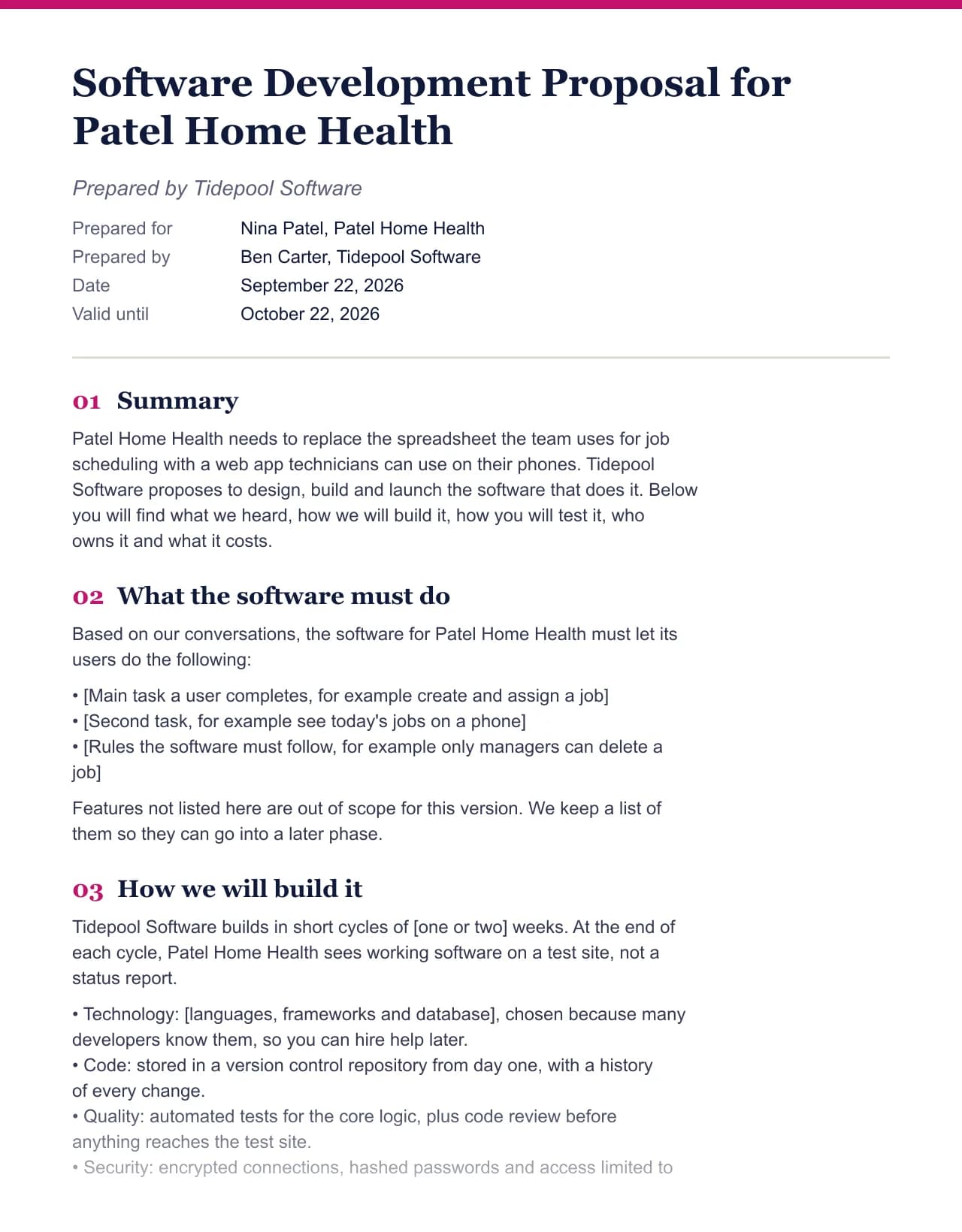
- Test input
- Tidepool Software (fictional) writing to Patel Home Health, with the default deliverables and prices for this field
- Output
- Software Development Proposal, 12 sections
- Words
- 781
- Sections
- 12
- Price options
- 2
- Placeholders left
- 10
- Word file size
- 12 KB
- Generation time
- 1 ms
How we test: every page uses the same input, and we check each output by hand. More on the about page.
The full software proposal template, section by section
This is the exact text the generator starts from. It fits a custom web or mobile app for a small business, so add sections on integrations and data migration for a larger system.
Text in square brackets is yours to fill in. The tool above fills it for you, and the notes explain why each section is there.
Software Development Proposal for [Client company]
- Prepared for
- [Client name], [Client company]
- Prepared by
- [Your name], [Your business]
- Date
- [date]
- Valid until
- [date]
01Summary
Why this section: The person who approves a software budget is often not the person who asked for the app. A short summary in business terms, with no jargon, lets that person understand the project and the cost in one minute.
[Client company] needs to [reach the client's goal]. [Your business] proposes to design, build and launch the software that does it. Below you will find what we heard, how we will build it, how you will test it, who owns it and what it costs.
02What the software must do
Why this section: Most software projects that go wrong were built against a different picture of the product. Writing the requirements down, including what is out of scope for this version, gives both sides the same picture before any code exists.
Based on our conversations, the software for [Client company] must let its users do the following:
- [Main task a user completes, for example create and assign a job]
- [Second task, for example see today's jobs on a phone]
- [Rules the software must follow, for example only managers can delete a job]
Features not listed here are out of scope for this version. We keep a list of them so they can go into a later phase.
03How we will build it
Why this section: Clients want to know the software will be maintainable after you are gone. Naming the stack, the hosting model and the way you work in short cycles answers that without drowning them in detail.
[Your business] builds in short cycles of [one or two] weeks. At the end of each cycle, [Client company] sees working software on a test site, not a status report.
- Technology: [languages, frameworks and database], chosen because many developers know them, so you can hire help later.
- Code: stored in a version control repository from day one, with a history of every change.
- Quality: automated tests for the core logic, plus code review before anything reaches the test site.
- Security: encrypted connections, hashed passwords and access limited to the people who need it.
04What we will build
Why this section: A numbered list of what the client gets is the part they read twice. A clear list also protects you: anything not on it is extra work with an extra price.
[Your business] will deliver the following for [Client company]:
- Requirements workshop and a written list of user stories
- Clickable prototype of the main screens for approval
- Web app with login, job scheduling and a technician view for phones
- Import of existing jobs from the current spreadsheet
- Deployment to your hosting account with setup notes
- 30 days of bug fixes after launch
Anything not on this list is outside the scope of this proposal. If the project needs more, we will agree on it in writing before any extra work starts.
05Milestones
Why this section: A software timeline is only believable when it is broken into milestones the client can see and approve. Each one is also a natural point to catch a misunderstanding while it is still cheap to fix.
| Milestone | What you see | Your part |
|---|---|---|
| 1. Discovery | User stories and a clickable prototype | Join the workshop, approve the prototype |
| 2. Core build | Main features working on a test site | Try them and send feedback |
| 3. Complete build | All features in scope, data imported | Run the acceptance tests |
| 4. Launch | Software live on your hosting | Approve the go live date |
06Timeline
Why this section: Clients plan around your dates. So state the length, say when the clock starts and say what happens when feedback is late.
The work takes [timeline, for example 6 weeks] from the day this proposal is accepted and the first payment arrives.
The schedule assumes feedback within two business days at each review point. If materials or approvals arrive later, the dates move by the same number of days.
07Testing and sign-off
Why this section: Without agreed acceptance criteria, a software project never quite ends. Defining how the client tests each milestone, how long they have and what counts as a defect gives the project a clear finish line.
Before signing off each milestone, [Client company] tests it against the requirements above. You have [number] business days to test and report issues. We fix every defect, meaning anything that does not work as the requirements describe, at no extra cost.
New ideas that come up during testing are welcome. We log them as change requests, estimate them and add them only if you approve the time and cost.
08Cost
Why this section: Show the price in a table next to what it buys. Two or three options let the client choose a level instead of saying yes or no to a single number.
There are 2 options below, so [Client company] can choose the level that fits the budget and the goal.
| Option | What is included | Price |
|---|---|---|
| Core app | Scheduling, technician view and data import | [price] |
| Core app with reporting | Core app plus a reporting dashboard and CSV export | [price] |
Payment terms: [payment terms, for example 50% to start and 50% on delivery].
All prices are in USD.
09Hosting and maintenance
Why this section: Software keeps costing money after launch: hosting, updates and security patches. Stating who pays for hosting and what maintenance covers prevents a surprise bill and a neglected app a year later.
- Hosting: the software runs on an account owned by [Client company]. You pay hosting fees directly to the provider, outside our fee.
- Maintenance: after the support period, we offer an optional plan for updates, security patches and small fixes at [monthly fee or hourly rate].
- Third party services: any paid services the software uses, such as email or maps, bill your account directly.
10Who owns the code
Why this section: Code ownership is the question buyers are most afraid to ask. Saying plainly that they own the code and receive the source once paid removes a reason to delay, and naming any reused libraries keeps it honest.
Once all fees are paid, [Client company] owns the custom code written for this project and receives the full source code and repository access.
Open source libraries keep their own licenses. [Your business] keeps the right to reuse general tools and know-how that are not specific to [Client company], but never your data or your business logic.
11Support after launch
Why this section: Real users find problems that testing missed. A defined support window after launch, with a way to report issues and a response time, tells the client they will not be left alone on day one.
After launch, [Your business] fixes defects for [support period] at no charge. Report issues by [email or ticket link], and we respond within [response time] on business days.
Payment terms for the project: [payment terms, for example 50% to start and 50% on delivery]. We quote changes and new features after launch separately.
12Next steps
Why this section: End with one clear action and a signature block. An expiry date gives the client a reason to decide and protects you from old prices.
To go ahead, sign below and reply to this proposal. We then send the first invoice and book the kickoff call.
This proposal is valid until [date] (30 days).
| [Your business] | [Client company] | |
|---|---|---|
| Name | [Your name] | [Client name] |
| Signature | ||
| Date |
What a software proposal template must answer
A client buying custom software has three fears: the app will not do what they pictured, it will arrive late, and they will be stuck with a developer they cannot leave. A good proposal answers each fear in writing before the client has to ask.
In this software proposal template, the requirements section and the milestone table deal with the first two. The client sees what the software must do, what is out of scope for this version, and working software at each milestone. As a result, a misunderstanding shows up in week two instead of on launch day.
The ownership and hosting sections deal with the third fear. When the client owns the code, holds the hosting account and gets the repository, they can switch developers at any time. Oddly, saying so makes them more likely to stay.
How to price custom software in a proposal
Most small studios price custom software as a fixed fee per phase or as time and materials with an estimate. A fixed fee suits a well defined first version. Time and materials suits projects where the requirements will change, but then the client needs a budget cap and regular reports.
Our software proposal template shows options tied to feature sets, such as a core app and a core app with reporting. That way the client can trade features for budget instead of asking you to cut your rate. Also, tie payments to milestones, so each payment follows something the client has seen working.
Finally, keep running costs separate from the build fee. Hosting, third party services and a maintenance plan continue after launch, and a client who learns about them late feels misled.
Acceptance testing and support after launch
Software projects need a finish line. The acceptance section gives the client a fixed number of days to test each milestone against the requirements, defines a defect as anything that does not work as described, and treats new ideas as change requests.
After launch, real users will find issues that testing missed. For that reason, the template promises a support window with a response time, then offers an optional maintenance plan. Both are placeholders, because only you know what you can commit to.
When this template is not the right fit
If the client sends a formal request for proposal, answer in their format and use this software proposal template as a checklist. Enterprise and government buyers often require security questionnaires, service level terms and a master services agreement that go well beyond a proposal.
Similarly, if you sell an existing software product rather than building one, a sales quote or order form fits better. This template is for custom development work where the client pays for something that does not exist yet.
Sections in the software proposal template
| Section | What the client learns |
|---|---|
| Summary | The goal and the cost in business terms, for the budget holder |
| Requirements | What the software must do, and what waits for a later phase |
| Technical approach | Stack, build cycles, code quality and security basics |
| Scope and milestones | The deliverables and what they can review at each step |
| Timeline | How long the build takes and when the clock starts |
| Acceptance testing | How they test, how long they have and what counts as a defect |
| Fees | Options tied to feature sets, and the payment terms |
| Hosting and maintenance | Who pays for hosting and what upkeep costs after launch |
| Code ownership | That they own the custom code and receive the source |
| Support after launch | How long you fix defects and how to report them |
Software proposal template FAQ
What should a software development proposal include?
It should include a summary, a requirements list, your technical approach, the deliverables, milestones, a timeline, acceptance criteria, fees, hosting and maintenance terms, code ownership and support after launch.
How do I write a software proposal?
Start from the business goal, list what users must be able to do, then plan the build in milestones the client can review. A software proposal template like this one gives you the sections, so you fill in the facts.
Who owns the source code in a custom software project?
It depends on the contract, so say it in the proposal. This template states that the client owns the custom code once paid, while open source libraries keep their own licenses.
Should I quote a fixed price or hourly for software?
A fixed price works for a well defined first version. Time and materials works when requirements will change, but add a budget cap and regular progress reports.
What are acceptance criteria in a software proposal?
They are the conditions a milestone must meet before the client signs it off. In this template, the requirements list is the test, and the client has a set number of days to report defects.
Is this software proposal template free?
Yes. Reading the template, generating a filled proposal, editing it and downloading the Word file are free with no account. It only uses the details and prices you type in.