Research proposal template
A research proposal template lays out the parts a supervisor or review committee expects: title and abstract, background, literature review, research questions, methodology, ethics, timeline, expected outputs, budget and references. Read the full template below, or fill in the short form to get a structured draft you can edit and download as a Word file, free.
By The Clinchdraft team (Product and testing). Last updated .
How to fill in a research proposal template, step by step
- Check your department or funder guidelines for the word limit, required headings and citation style.
- Enter your institution or lab as the applicant and your supervisor, committee or funding body as the recipient.
- Write the research aim as a verb phrase, such as find out whether daily retrieval practice improves recall.
- List the outputs the study will produce, one per line, from the literature review to the final paper.
- Add the study length and, if you need funding, one or two budget options with what each covers.
- Generate the draft, then replace each bracketed placeholder with your own sources, design and ethics details.
Generating a proposal is free and needs no account. Tailoring it to a client brief uses a credit, so see the pricing page for packs and plans, or read how we test the templates.
Research proposal template tested with a real input
We ran a fictional business and client through this exact generator. Every number below comes from that run, including the size of the Word file the download button produces.
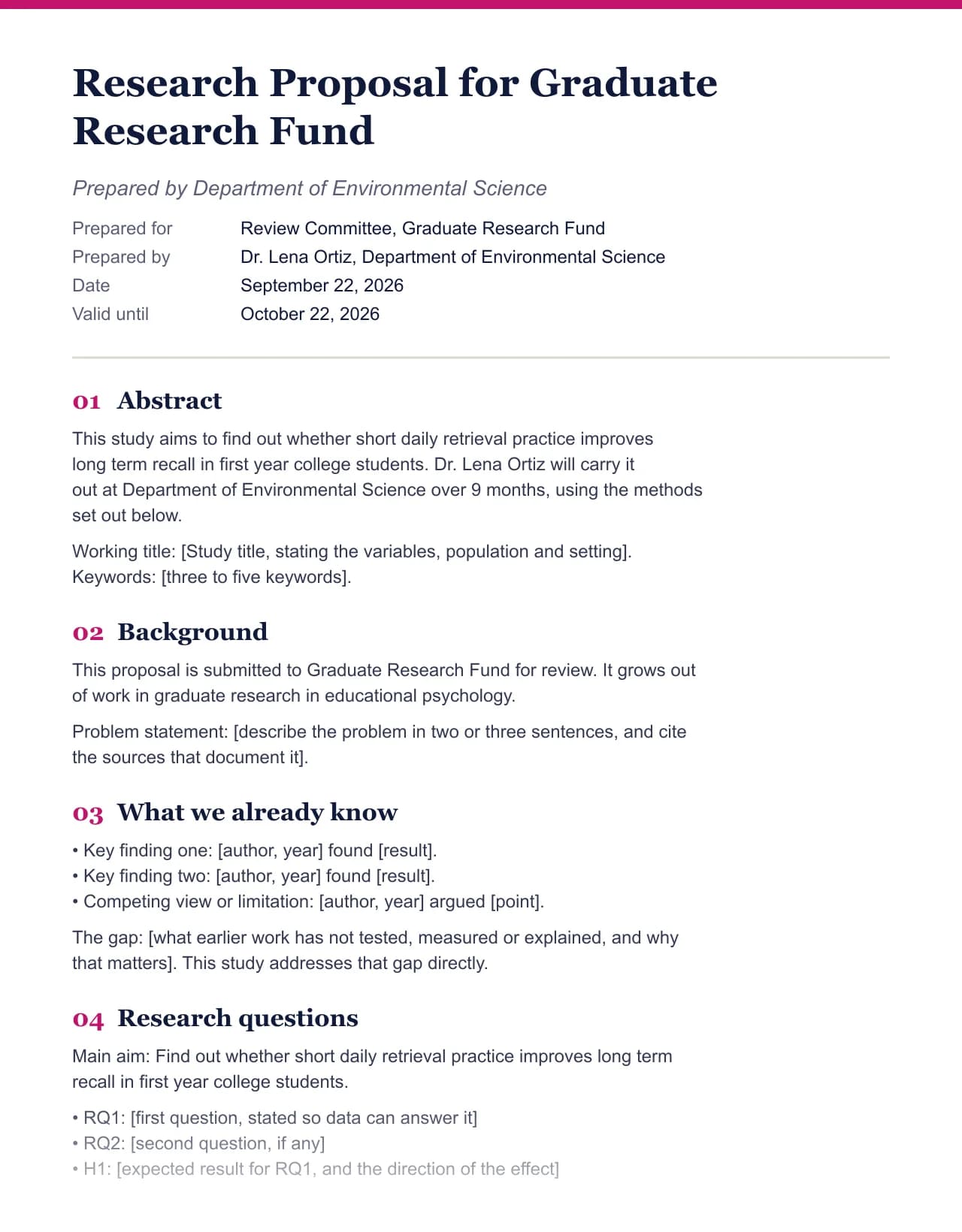
- Test input
- Department of Environmental Science (fictional) writing to Graduate Research Fund, with the default deliverables and prices for this field
- Output
- Research Proposal, 11 sections
- Words
- 626
- Sections
- 11
- Price options
- 2
- Placeholders left
- 21
- Word file size
- 12 KB
- Generation time
- 1 ms
How we test: every page uses the same input, and we check each output by hand. More on the about page.
The full research proposal template, section by section
This is the exact text the generator starts from. It is set up for a master's or doctoral study with human participants, so drop the ethics section for purely theoretical work and expand the methods for a funded grant.
Text in square brackets is yours to fill in. The tool above fills it for you, and the notes explain why each section is there.
Research Proposal for [Client company]
- Prepared for
- [Client name], [Client company]
- Prepared by
- [Your name], [Your business]
- Date
- [date]
- Valid until
- [date]
01Abstract
Why this section: Committees and review panels read the abstract first and sometimes only the abstract. In about 150 words it must state the problem, the question, the method and why the answer matters.
This study aims to [reach the client's goal]. [Your name] will carry it out at [Your business] over [timeline, for example 6 weeks], using the methods set out below.
Working title: [Study title, stating the variables, population and setting]. Keywords: [three to five keywords].
02Background
Why this section: The background shows reviewers that the problem is real and worth studying now. It sets the scene in plain terms before the literature review goes into who has found what.
This proposal is submitted to [Client company] for review. It grows out of work in [what you do, in one line].
Problem statement: [describe the problem in two or three sentences, and cite the sources that document it].
03What we already know
Why this section: A literature review proves you know the field and shows the exact gap your study fills. Reviewers look for recent, relevant sources and a clear line from past findings to your question.
- Key finding one: [author, year] found [result].
- Key finding two: [author, year] found [result].
- Competing view or limitation: [author, year] argued [point].
The gap: [what earlier work has not tested, measured or explained, and why that matters]. This study addresses that gap directly.
04Research questions
Why this section: Everything else in the proposal follows from the questions. Clear, answerable questions and testable hypotheses tell the committee what counts as a result and keep the study from drifting.
Main aim: [reach the client's goal].
- RQ1: [first question, stated so data can answer it]
- RQ2: [second question, if any]
- H1: [expected result for RQ1, and the direction of the effect]
05Methods
Why this section: The methodology is the part reviewers test hardest. It must match the question, name the sample and instruments, and explain the analysis well enough that another researcher could repeat the study.
| Element | Plan |
|---|---|
| Design | [for example experimental, survey, case study or mixed methods] |
| Participants | [who, how many, and how they are recruited] |
| Data collection | [instruments, interviews or records, and when they are used] |
| Analysis | [statistical tests or coding approach, and the software] |
[Your name] will run the study and keep a data management plan so that raw data, code and notes are stored securely and can be checked.
06Ethics
Why this section: Any study with human participants needs ethics approval before data collection starts. Stating how you handle consent, privacy and risk shows the committee the study can pass review without delays.
- Approval: the study will be submitted to [IRB or ethics committee name] and no data will be collected before approval. Protocol number: [number, once issued].
- Consent: every participant receives an information sheet and gives written informed consent. They can withdraw at any time.
- Privacy: data are stored without names, on [secure storage], and kept for [retention period].
- Risk: [expected risks to participants, if any, and how they are reduced].
07Timeline
Why this section: Supervisors and funders check that the plan fits the degree clock or the grant period. A phase by phase schedule shows the study can finish on time, with room for ethics review and writing.
The study runs for [timeline, for example 6 weeks] from approval of this proposal.
| Phase | Main tasks |
|---|---|
| 1. Preparation | Finish the literature review, build instruments, submit for ethics approval |
| 2. Data collection | Recruit participants and collect data once approval is granted |
| 3. Analysis | Clean, analyze and interpret the data |
| 4. Writing | Draft, revise and submit the final report or thesis chapter |
Ethics review can take several weeks, so data collection dates move if approval arrives later than planned.
08Expected outputs
Why this section: Reviewers want to know what exists at the end: data, a thesis chapter, a paper or a public dataset. Listing outputs makes the study concrete and easy to assess against the fund's goals.
[Your business] will deliver the following for [Client company]:
- A literature review of retrieval practice studies
- A study protocol and survey instruments approved by the ethics board
- Data from an eight week classroom study with two course sections
- A statistical analysis of recall scores between groups
- A written thesis chapter and a conference paper draft
Anything not on this list is outside the scope of this proposal. If the project needs more, we will agree on it in writing before any extra work starts.
09Budget
Why this section: A research budget is judged on justification, not size. Tie each line to a method or activity so the committee can see why every cost is needed.
There are 2 options below, so [Client company] can choose the level that fits the budget and the goal.
| Option | What is included | Price |
|---|---|---|
| Core study | Participant incentives, survey software and transcription | [price] |
| Study with dissemination | Core study plus conference registration and travel | [price] |
Payment terms: [payment terms, for example 50% to start and 50% on delivery].
All prices are in USD.
10Why it matters
Why this section: Committees and funders ask the same question at the end: so what? This section names who will use the results and what the study adds to theory, practice or policy.
If the study meets its aim, it will add evidence on a question that earlier work left open. Results will be shared with [Client company] and submitted for publication.
Intended audience: [researchers, practitioners or policy makers who will use the findings].
11Submission details
Why this section: The closing section makes the proposal easy to process: who submits it, to whom, and until when the plan and budget hold. A reference list in one standard style signals academic care.
Submitted by [Your name], [Your business], to [Client name]. The plan and budget hold until [date].
References: [full list in APA, MLA or the style your department requires]. Appendices: [instruments, consent form, letters of support].
What a research proposal needs to prove
A research proposal is an argument, not a form. It has to convince a reader that the question matters, that nobody has fully answered it yet, and that your design can answer it within the time and money you have. Every section in the template serves one of those three claims.
For that reason, the research proposal template moves from the broad to the specific. First the background and literature review show the gap. Then the research questions state exactly what you will test. Finally, the methodology, ethics and timeline show that the study is feasible, and the budget shows what it costs.
Committees also read for fit. In other words, the question, the method and the analysis must match. A causal question needs a design that can support a causal claim, while an exploratory question often suits interviews or a case study better.
How to use this research proposal template for a thesis or a grant
For a thesis or dissertation, the reader is your supervisor and committee. They care most about the literature review, the research questions and whether you can finish before your funding or enrollment ends. So keep the budget short, and spend your words on the gap and the design.
For a funded study, however, the budget and the expected outcomes carry more weight. Funders want to know what the money buys and who will use the results. The template includes a budget table with one or two options and a section on significance, so you can scale the same draft up or down.
In both cases, the references matter. Use the citation style your department or funder requires, and keep every claim in the background tied to a source. The generator never adds a citation, because a reference you have not read is worse than a gap.
Planning ethics approval and the timeline
Any study with human participants needs approval from an institutional review board or ethics committee before data collection starts. As a result, the timeline in this research proposal template puts ethics review inside the preparation phase, so a slow review moves your dates instead of breaking the plan.
Also describe consent, privacy and data storage in plain terms. Reviewers look for how you will recruit people, what they are told, how they can withdraw and where the data will live. Those answers are usually the same ones your ethics application will ask for.
When this research proposal template is not the right fit
Large agency grants, such as those from the NSF or NIH, follow their own required structure, page limits and forms. In that case, use the agency guide as your outline and this template only as a checklist. Likewise, some universities publish their own proposal form, and that form always comes first.
On the other hand, a nonprofit asking a foundation to fund a community program needs a need statement and a sustainability plan more than a literature review. For that, the grant proposal template on this site is a better match.
Sections in the research proposal template
| Section | What the reviewer learns |
|---|---|
| Abstract | The problem, question, method and why it matters, in brief |
| Background | Why the problem is real and worth studying now |
| Literature review | What earlier studies found and the gap this study fills |
| Research questions | The exact questions and hypotheses the data will answer |
| Methodology | Design, participants, data collection and analysis |
| Ethics | Approval, consent, privacy and risk to participants |
| Timeline | The phases of the study and how long each takes |
| Expected outputs | What the study will produce, one item per line |
| Budget | What the study costs and what each option covers |
| Significance and references | Who will use the results and the sources behind the proposal |
Research proposal template FAQ
What should a research proposal include?
Most proposals include a title, an abstract, background, a literature review, research questions or hypotheses, a methodology, ethical considerations, a timeline, a budget, expected outcomes and references. Your department or funder may add or rename sections, so check their guidelines first.
How do I write a research proposal?
Start with a clear question and read enough of the literature to show the gap it fills. Then choose a design that can answer the question, plan the ethics and timeline around it, and finish with the budget and references.
How long is a research proposal?
It depends on the program or funder. A master's proposal is often a few pages, while a doctoral or grant proposal can be much longer. Follow the word limit you were given and trim the template to fit.
Is this research proposal template free?
Yes. Reading the template, generating a filled draft, editing it and downloading the Word file are free with no account. Only the AI step that tailors a draft to pasted guidelines uses credits.
Does the template work for qualitative research?
Yes. The methodology section is a table you fill with your own design, so it works for interviews, case studies, surveys, experiments or mixed methods.
Does the generator write my literature review or add citations?
No. It builds the structure and fills in what you type, such as your aim, outputs and timeline. The literature, questions and references stay as placeholders for your own reading.