Investment proposal generator
This investment proposal generator turns a short form into a written proposal for an investor: the opportunity, problem and solution, market, traction, business model, team, use of funds, terms, risks and next steps. Your numbers appear exactly as you type them, and every fact you leave empty stays as a [placeholder].
By The Clinchdraft team (Product and testing). Last updated .
How to use the investment proposal generator, step by step
- Keep Investment selected as the proposal type.
- Describe your company in one line and the goal of the round as a verb phrase.
- List what the money will pay for, one line each, since these become the use of funds.
- Add one to three investment amounts, such as a lead check and a smaller participating check.
- Press Generate, then fill every placeholder in traction, market and team with facts you can prove.
- Finally, ask a lawyer to review the terms before the proposal goes to any investor.
Generating a proposal is free and needs no account. Tailoring it to a client brief uses a credit, so see the pricing page for packs and plans, or read how we test the templates.
Investment proposal generator tested with a real input
We ran a fictional business and client through this exact generator. Every number below comes from that run, including the size of the Word file the download button produces.
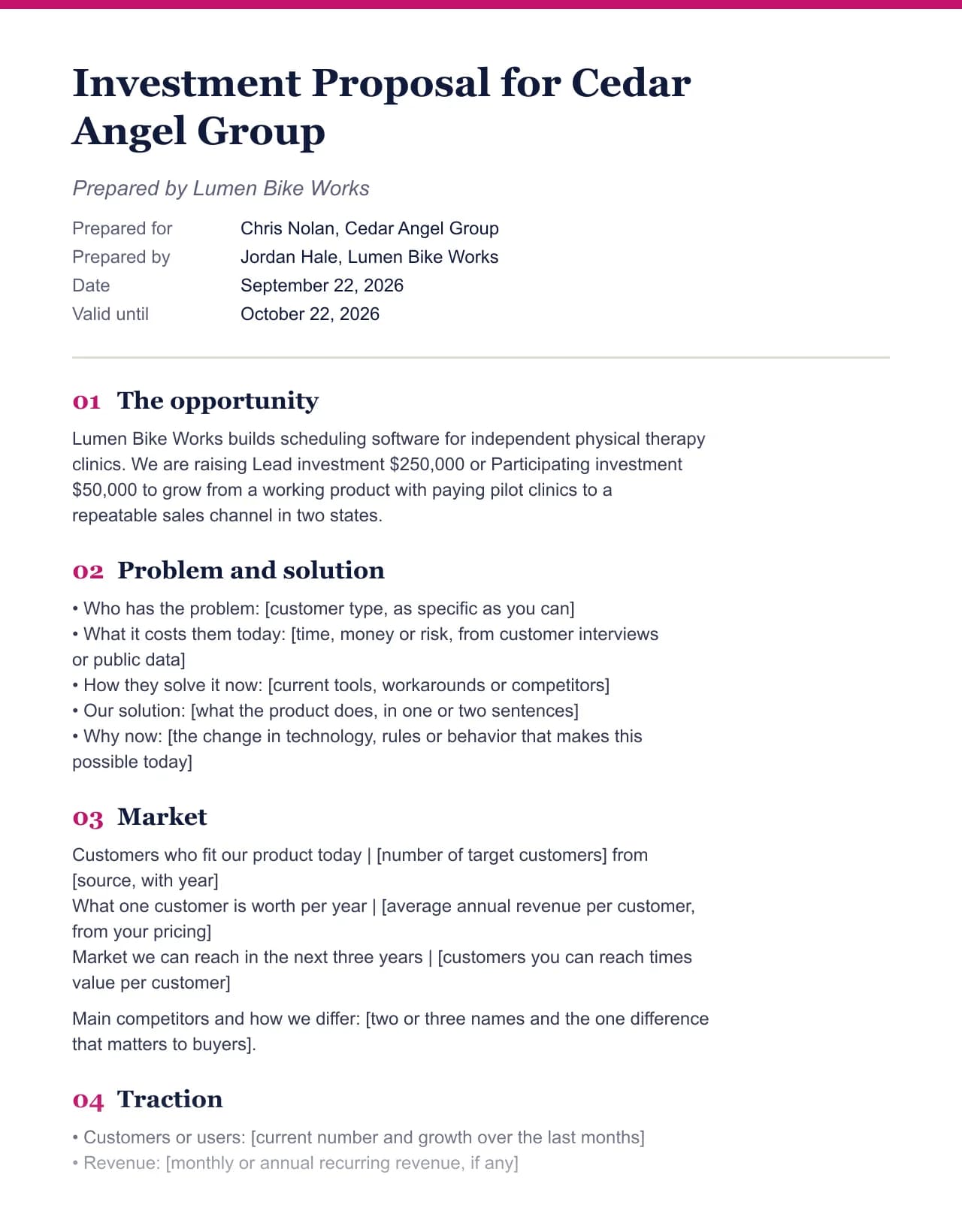
- Test input
- Lumen Bike Works (fictional) writing to Cedar Angel Group, with the default deliverables and prices for this field
- Output
- Investment Proposal, 11 sections
- Words
- 614
- Sections
- 11
- Price options
- 2
- Placeholders left
- 31
- Word file size
- 12 KB
- Generation time
- 1 ms
How we test: every page uses the same input, and we check each output by hand. More on the about page.
What the investment proposal generator writes
An investment proposal asks one person or a small group for money, so it has to answer the questions an investor asks in the first meeting. What is the problem? Who pays you? What will this money change? What could go wrong? Our template has one section for each question, plus the terms and a clear next step.
The deliverables you type become the use of funds, and the amounts become the investment options. For example, you might offer a lead amount that covers two hires and a smaller amount that joins the round. Because the draft is built from a fixed template, it never adds revenue, growth rates or valuations you did not enter.
However, the traction, market and team sections are where founders are most tempted to stretch the truth. So the generator leaves those facts as placeholders on purpose. Fill them with numbers you can show from your own records, and cite the source of any market size you use.
Investment proposal, pitch deck or business plan?
A pitch deck gets you the meeting. It is visual and short, and it leaves the detail for the conversation. A business plan, in contrast, is the long document a bank or a formal investor reads to test the whole company.
An investment proposal sits between them. It is a written document for a specific investor, often a local angel, a family office or a business partner, that states how much you want, what it pays for and on what terms. Many small raises never use a deck at all, and the proposal does the whole job.
If an investor asks for a deck, you can still use this draft as the script. After all, the order of sections maps closely to the usual deck slides.
Not legal or investment advice
This page and the generated proposal are not legal, tax or investment advice. Offering a share of a company to investors is regulated. In the United States, for example, most private raises rely on an exemption from registration, such as Regulation D, and some exemptions limit who may invest.
So treat the terms section as a starting point for a conversation, not as a contract. Before you send the proposal, ask a securities lawyer which exemption applies to you and what you must disclose. Also, keep the risks section honest, since leaving out a known risk can create legal trouble later.
Sections of the investment proposal and what each tells the investor
| Section | What the investor learns |
|---|---|
| The opportunity | What you are raising and the goal of the round, in one short page |
| Problem and solution | Who has the problem and how your product solves it |
| Market | Who buys, with a source for any size you quote |
| Traction | Customers, revenue or pilots you can prove, left blank for you to fill |
| Business model | How the company makes money |
| Team | Who does the work and why they can |
| Use of funds | What each line of spending buys, taken from your form |
| Terms | The amounts and structure you propose, for a lawyer to review |
| Risks | What could go wrong and how you plan for it |
Investment proposal generator FAQ
What should an investment proposal include?
It should cover the opportunity, the problem and solution, the market, traction, the business model, the team, the use of funds, the terms, the risks and the next step. The generator writes every one of these sections from your form.
How do I write an investment proposal for a small business?
Start with the amount and what it will pay for, then show proof that customers want the product. Keep the numbers real, name the risks and have a lawyer check the terms.
Is an investment proposal the same as a pitch deck?
No. A pitch deck is a short visual deck for a meeting, while an investment proposal is a written document with the amounts, the use of funds and the terms.
Does the investment proposal generator make up financial projections?
No. It uses only the numbers you enter, and it leaves traction, market and team facts as placeholders for you to fill with real data.
Is this legal or investment advice?
No. It is a writing tool. Raising money from investors is regulated, so talk to a securities lawyer before you send a proposal.