Investment proposal template
An investment proposal template gives a founder the sections an angel or small fund expects to read: the opportunity, problem and solution, market, traction, business model, team, the ask, use of funds, proposed terms and risks. Read the full template below, or fill in the short form to get a draft you can edit and download as a Word file, free.
By The Clinchdraft team (Product and testing). Last updated .
How to fill in an investment proposal template, step by step
- Enter your company as the applicant and the investor or fund as the recipient.
- Write what the round achieves as a verb phrase, such as grow from paying pilots to a repeatable sales channel.
- List four to six milestones the money pays for, one per line, so the use of funds is concrete.
- Add the amount you are raising, or two investment options, and state the runway it buys.
- Generate the draft, then fill every bracketed placeholder with figures you can back up in a data room.
- Finally, have a lawyer review the terms and the disclaimer before you send it to anyone.
Generating a proposal is free and needs no account. Tailoring it to a client brief uses a credit, so see the pricing page for packs and plans, or read how we test the templates.
Investment proposal template tested with a real input
We ran a fictional business and client through this exact generator. Every number below comes from that run, including the size of the Word file the download button produces.
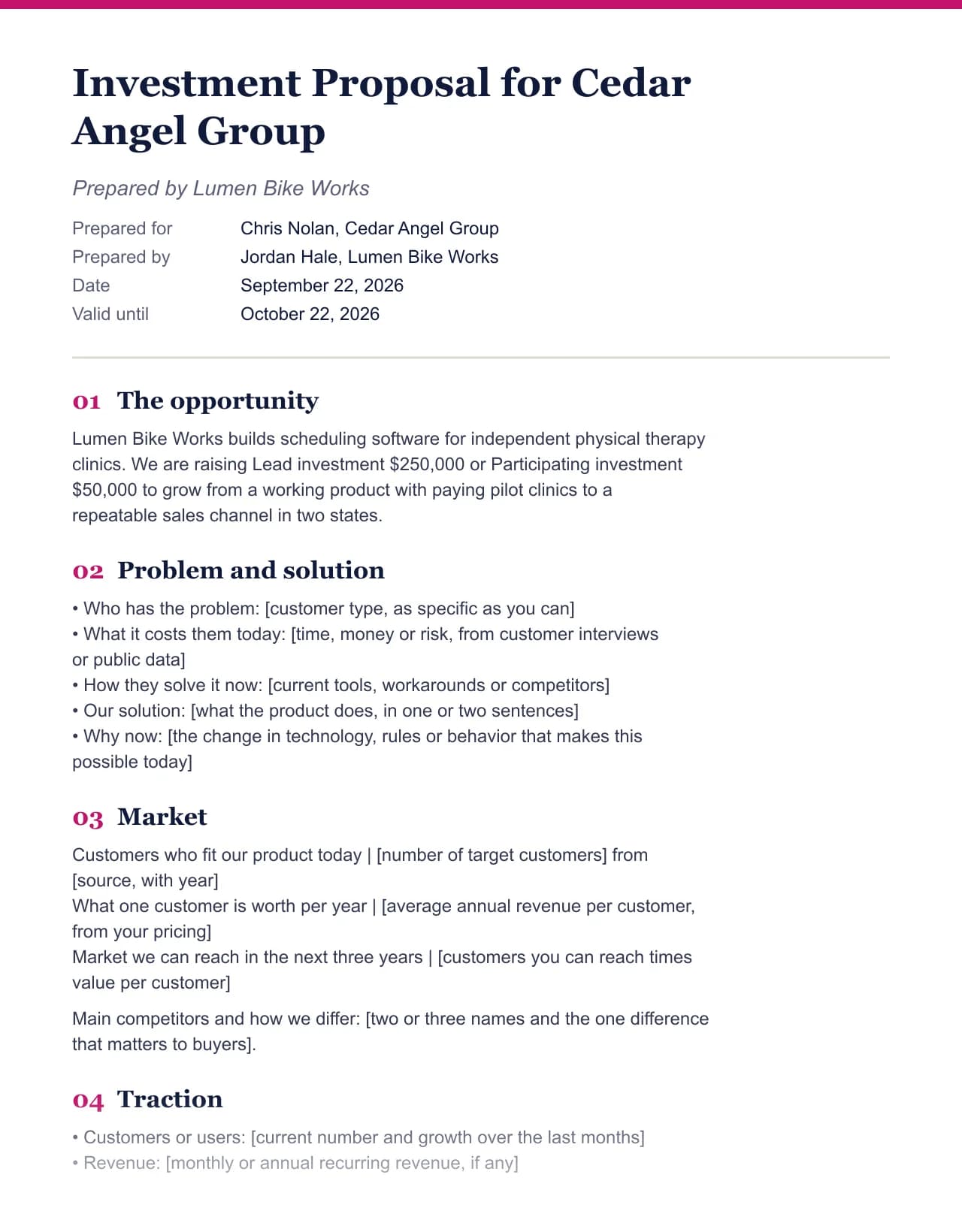
- Test input
- Lumen Bike Works (fictional) writing to Cedar Angel Group, with the default deliverables and prices for this field
- Output
- Investment Proposal, 11 sections
- Words
- 614
- Sections
- 11
- Price options
- 2
- Placeholders left
- 31
- Word file size
- 12 KB
- Generation time
- 1 ms
How we test: every page uses the same input, and we check each output by hand. More on the about page.
The full investment proposal template, section by section
This is the exact text the generator starts from. It is written for an early stage company raising from angels or a small fund, so cut it to a one page summary for a first email and expand the market and traction for a larger round.
Text in square brackets is yours to fill in. The tool above fills it for you, and the notes explain why each section is there.
Investment Proposal for [Client company]
- Prepared for
- [Client name], [Client company]
- Prepared by
- [Your name], [Your business]
- Date
- [date]
- Valid until
- [date]
01The opportunity
Why this section: Investors decide in the first minute whether to keep reading. The opening names the company, the problem, the ask and what the money achieves, so the rest of the document only has to back it up.
[Your business] builds [what you do, in one line]. We are raising [price] to [reach the client's goal].
02Problem and solution
Why this section: An investor funds a painful problem before a clever product. Describe who has the problem, what it costs them today and how your product removes it, in words a customer would use.
- Who has the problem: [customer type, as specific as you can]
- What it costs them today: [time, money or risk, from customer interviews or public data]
- How they solve it now: [current tools, workarounds or competitors]
- Our solution: [what the product does, in one or two sentences]
- Why now: [the change in technology, rules or behavior that makes this possible today]
03Market
Why this section: Investors need to see that the company can grow large enough to return their money. Build the market size from the bottom up, with named sources, rather than quoting one big top down figure.
| Measure | Figure and source |
|---|---|
| Customers who fit our product today | [number of target customers] from [source, with year] |
| What one customer is worth per year | [average annual revenue per customer, from your pricing] |
| Market we can reach in the next three years | [customers you can reach times value per customer] |
Main competitors and how we differ: [two or three names and the one difference that matters to buyers].
04Traction
Why this section: Evidence beats projections. Real numbers on customers, revenue, retention or pilots show the investor that the risk is lower than it looks, so list only what you can show in a data room.
- Customers or users: [current number and growth over the last months]
- Revenue: [monthly or annual recurring revenue, if any]
- Retention or engagement: [the metric that shows customers stay]
- Key milestones reached: [launches, partnerships, pilots]
05Business model
Why this section: Investors want to know how each customer turns into revenue and at what cost. Pricing, sales channel and unit economics show whether growth will create value or burn cash.
- Pricing: [price and billing model, for example monthly per location]
- Sales channel: [how customers find and buy the product]
- Cost to acquire a customer: [figure and how it was measured, or a placeholder until you have data]
- Gross margin: [figure, or your target with the reasoning]
06Team
Why this section: At an early stage the investor is betting on people as much as on the product. Show why this team is the right one to solve this problem, with real roles and relevant experience only.
[Your name] leads [Your business] and is the contact for this proposal.
- [Founder name, role]: [relevant experience]
- [Cofounder or key hire, role]: [relevant experience]
- Advisors: [names and what they help with, if any]
07The ask
Why this section: Investors look for a specific amount and what it buys. Stating the ask plainly, with options if you have them, starts the terms conversation instead of leaving the investor to guess.
There are 2 options below, so [Client company] can choose the level that fits the budget and the goal.
| Option | What is included | Price |
|---|---|---|
| Lead investment | Covers both hires and the security review | [price] |
| Participating investment | Joins the round alongside the lead investor | [price] |
Payment terms: [payment terms, for example 50% to start and 50% on delivery].
All prices are in USD.
08Use of funds
Why this section: Investors fund milestones, not expenses. Tying each part of the round to a concrete result shows how the money moves the company to the next stage and what they can hold you to.
The round funds [timeline, for example 6 weeks]. In that time [Your business] will use the money to reach these milestones:
- Hire one full time engineer to finish the billing integration
- Hire one sales lead focused on clinics with two to ten therapists
- Launch a referral program for existing clinic customers
- Complete a security review before selling to larger clinic groups
- Report monthly metrics to investors throughout the round
Split of funds: [share for product, sales and marketing, operations and reserve].
09Terms
Why this section: Stating the instrument and the key terms up front saves both sides time. Leave the details to counsel, but say whether this is a SAFE, a convertible note or priced equity.
- Instrument: [SAFE, convertible note or priced equity round]
- Valuation cap or pre money valuation: [figure, set with your advisers]
- Discount, interest or other terms: [if any]
- Investor updates: monthly metrics and a quarterly summary
- Minimum check size and closing date: [amount and date]
10Risks
Why this section: Every experienced investor will list the risks anyway. Naming them yourself, with a plan for each, builds trust and shows you understand the business you are running.
| Risk | How we reduce it |
|---|---|
| Customers adopt more slowly than planned | [plan, for example a longer pilot or a cheaper starter plan] |
| A larger competitor enters the market | [what keeps customers with you] |
| Key hires take longer to find | [backup plan] |
| The round funds less runway than planned | [costs you can cut first] |
Early stage companies can fail and investors can lose all of the money they invest.
11Next steps
Why this section: Close with one clear action, a contact person and a date. A deadline keeps the round moving, and a plain disclaimer reminds everyone that the legal documents, not this proposal, set the terms.
If you would like to go further, [Client name], reply to [Your name] to book a call or ask for the data room. The terms in this proposal are open until [date].
This proposal is for discussion only. It is not an offer to sell or a solicitation to buy securities, and any investment is subject to final legal documents. Founders should get legal and tax advice before sharing it or accepting funds.
What an investment proposal is, and what it is not
An investment proposal is a written case for putting money into your company. It usually travels alongside a pitch deck. The deck gets the meeting, while the proposal gives the investor something to read slowly, forward to a partner and check against your data room.
However, it is not an offering document. The actual investment happens through legal agreements such as a SAFE, a convertible note or a stock purchase agreement. For that reason, the investment proposal template ends with a plain statement that it is not an offer of securities, and it leaves every term as a placeholder for you and your lawyer to set.
Securities rules also limit who you can approach and how. In the United States, many private rounds are open only to accredited investors. So get legal advice before you share the document widely or post it anywhere public.
How to fill in the market and traction sections
Investors discount big top down market figures. Instead, build the market from the bottom up: the number of customers who fit your product today, times what one customer pays per year. The investment proposal template gives you a small table for exactly that, with a column for the source of each figure.
Traction works the same way. Real numbers on customers, revenue, retention or pilots carry far more weight than projections. If you are pre revenue, say so and list the milestones you have reached instead. In short, write only what you can show on request, because an investor will ask.
The generator never fills these sections for you. As a result, every figure in the final document is one you typed and can defend.
How to present the ask in an investment proposal template
State the amount, the instrument and the runway in one place. Then tie the money to milestones, such as two key hires or a product launch, so the investor sees what the round moves the company toward. The template puts the ask table right before the use of funds for this reason.
Two options can help too. For example, a lead check and a smaller participating check let one investor lead while others join. Name each option by its role in the round rather than by size alone.
When this investment proposal template is not the right fit
A priced round with a lead fund usually runs on the fund's own process, a term sheet and a full data room. In that case, the template is a useful checklist but not the main document. Likewise, a bank loan application needs a business plan and financial statements in the lender's format, not a pitch to an investor.
Crowdfunding and public offerings have their own disclosure rules. Do not use this template to raise money from the general public without advice from a securities lawyer.
Sections in the investment proposal template
| Section | What the investor learns |
|---|---|
| The opportunity | What the company does, how much it is raising and why |
| Problem and solution | Who has the problem, what it costs them and how you fix it |
| Market | A bottom up market size with a source for each figure |
| Traction | Customers, revenue and milestones you can show |
| Business model | Pricing, sales channel and unit economics |
| Team | Who runs the company and why they fit the problem |
| The ask | The amount or options, with payment details |
| Use of funds | The milestones the money pays for and the runway it buys |
| Terms and risks | The proposed instrument and the main risks with a plan for each |
| Next steps | Who to contact, the deadline and a securities disclaimer |
Investment proposal template FAQ
What should an investment proposal include?
It should cover the opportunity, the problem and your solution, the market, traction, the business model, the team, the amount you are raising, how you will use it, the proposed terms and the main risks. The template on this page has all of them in that order.
How do I write an investment proposal for a startup?
Start with a one paragraph summary of the company and the ask. Then back it up with the problem, market, traction and team, and tie the money to specific milestones. Keep every number sourced and let a lawyer set the terms.
Is an investment proposal the same as a pitch deck?
No. A pitch deck is a short visual story for a meeting, while an investment proposal is a written document the investor reads in detail. Many founders send both.
Is this investment proposal template free?
Yes. Reading the template, generating a filled draft, editing it and downloading the Word file are free with no account. Only the AI step that tailors a draft to pasted notes uses credits.
Do I need a lawyer for an investment proposal?
You should get legal advice before sending it and before accepting any money. Securities laws decide who you can raise from and what you must disclose, and the final agreements set the real terms.
Does the generator add market size or valuation figures?
No. It fills the template only with what you type in the form. Market size, traction, valuation and terms stay as bracketed placeholders until you add your own figures.