Event proposal template
An event proposal template lays out what a client needs to approve a planner: event details, how you plan, vendors and logistics, the event day, your fee and the cancellation terms. Read the full template below, or fill in the short form and get a finished event proposal to edit and download, free.
By The Clinchdraft team (Product and testing). Last updated .
How to fill in an event proposal template, step by step
- Confirm the basics on the first call: date, venue or area, guest count and the kind of event.
- Write the client's goal as a verb phrase, such as host an offsite that runs on time.
- List the services you will handle, from venue search to on-site coordination, one line each.
- Add one to three planning fee options, for example day-of coordination, partial planning and full planning.
- Press Generate, then fill the bracketed event details and check the cancellation terms against your contracts.
- Download the Word file or save it as a PDF and send it while the date is still open.
Generating a proposal is free and needs no account. Tailoring it to a client brief uses a credit, so see the pricing page for packs and plans, or read how we test the templates.
Event proposal template tested with a real input
We ran a fictional business and client through this exact generator. Every number below comes from that run, including the size of the Word file the download button produces.
- Test input
- Juniper Day Events (fictional) writing to Brightwater Credit Union, with the default deliverables and prices for this field
- Output
- Event Proposal, 11 sections
- Words
- 905
- Sections
- 11
- Price options
- 3
- Placeholders left
- 5
- Word file size
- 13 KB
- Generation time
- 1 ms
How we test: every page uses the same input, and we check each output by hand. More on the about page.
The full event proposal template, section by section
This is the exact text the generator starts from. It fits a corporate offsite or a private celebration, so shorten the vendor section for a small dinner and expand it for a multi-day conference.
Text in square brackets is yours to fill in. The tool above fills it for you, and the notes explain why each section is there.
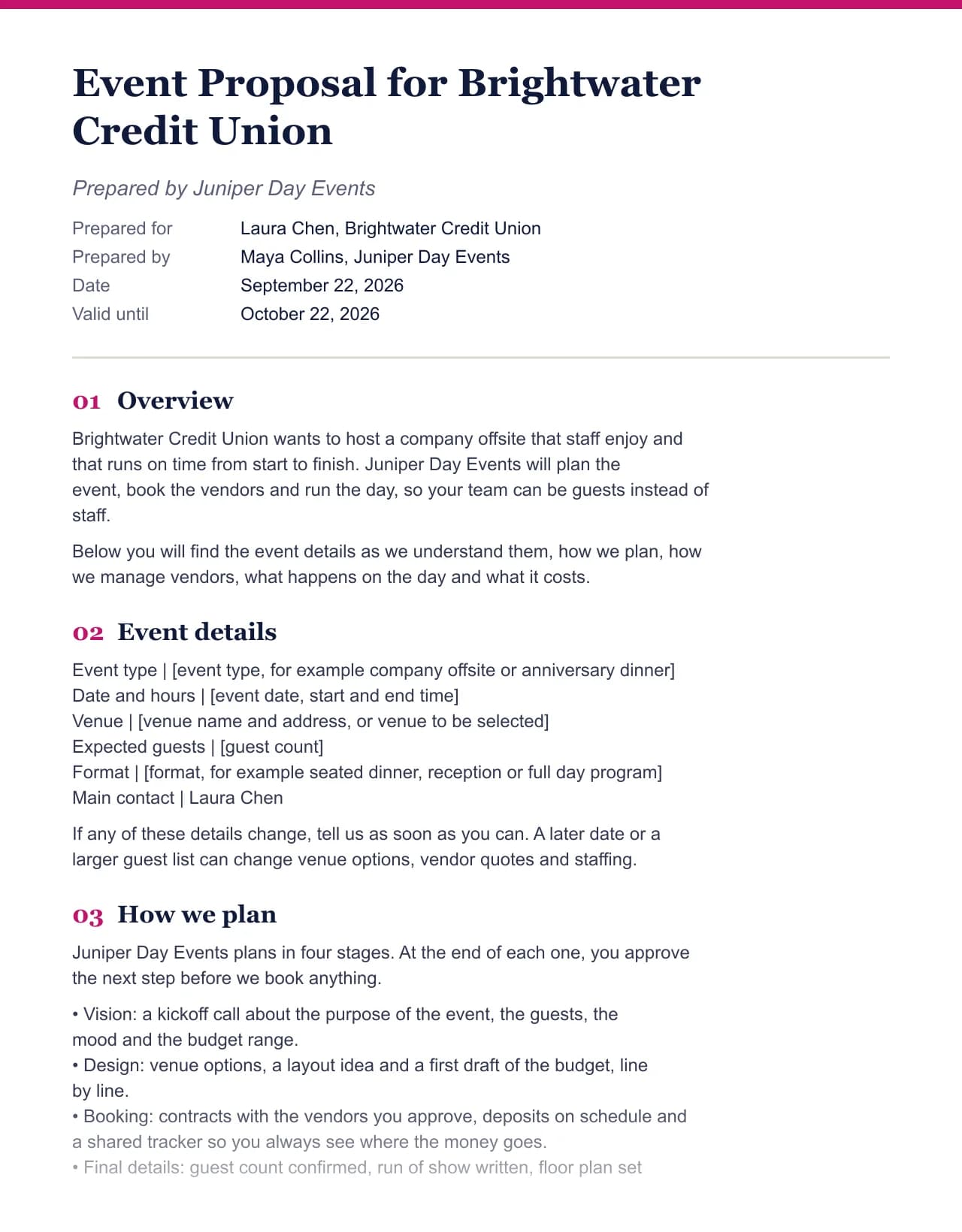
Event Proposal for [Client company]
- Prepared for
- [Client name], [Client company]
- Prepared by
- [Your name], [Your business]
- Date
- [date]
- Valid until
- [date]
01Overview
Why this section: Event clients picture the day before they read the price. So the overview restates the goal of the event in their words and tells them the rest of the document explains how the day will come together.
[Client company] wants to [reach the client's goal]. [Your business] will plan the event, book the vendors and run the day, so your team can be guests instead of staff.
Below you will find the event details as we understand them, how we plan, how we manage vendors, what happens on the day and what it costs.
02Event details
Why this section: Date, venue, guest count and format drive every cost in an event budget. Writing them down early catches a wrong date or a larger guest list before any deposit goes out.
| Item | Details |
|---|---|
| Event type | [event type, for example company offsite or anniversary dinner] |
| Date and hours | [event date, start and end time] |
| Venue | [venue name and address, or venue to be selected] |
| Expected guests | [guest count] |
| Format | [format, for example seated dinner, reception or full day program] |
| Main contact | [Client name] |
If any of these details change, tell us as soon as you can. A later date or a larger guest list can change venue options, vendor quotes and staffing.
03How we plan
Why this section: Clients hire a planner to take decisions off their plate without losing control. Showing the planning stages and the points where they approve something builds that trust.
[Your business] plans in four stages. At the end of each one, you approve the next step before we book anything.
- Vision: a kickoff call about the purpose of the event, the guests, the mood and the budget range.
- Design: venue options, a layout idea and a first draft of the budget, line by line.
- Booking: contracts with the vendors you approve, deposits on schedule and a shared tracker so you always see where the money goes.
- Final details: guest count confirmed, run of show written, floor plan set and a final walkthrough with the venue.
We need one decision maker at [Client company] and replies within two business days during booking, because vendors often hold dates only for a short time.
04Vendors and logistics
Why this section: Most event problems start with a vendor: a late delivery, a missing cable, a caterer who planned for fewer guests. This section shows who manages each vendor and who signs the contracts.
We source and compare vendors for each part of the event, then recommend one or two per category with the reasons. You choose, and we handle the booking.
- Categories: venue, catering, bar, audio and video, rentals, decor, photography, transport and entertainment, as the event needs.
- Contracts: vendors contract with you directly, and we review each contract for dates, deposits and cancellation terms before you sign.
- Logistics: load in and load out times, parking, access, power, permits where the venue requires them and a wet weather plan for any outdoor part.
- Payments: we track every deposit and final payment date in the budget tracker and remind you before each one is due.
05On the day
Why this section: The event day is what the client actually pays for. Spelling out arrival times, the run of show and who solves problems tells them they will not have to manage anything once guests arrive.
On the event day, [Your business] arrives before the first vendor and stays until the last one leaves. We follow a written run of show that you approve in advance.
- Vendor arrival, setup and checks against the floor plan.
- Timing cues for speeches, meals, music and any program items.
- One point of contact for vendors and venue staff, so questions come to us and not to you or your guests.
- Breakdown, a check that nothing is left behind and a short wrap-up the next business day.
06What we handle
Why this section: A numbered list of what the client gets is the part they read twice. A clear list also protects you: anything not on it is extra work with an extra price.
[Your business] will deliver the following for [Client company]:
- Venue search with up to three shortlisted options and site visits
- Vendor sourcing and booking for catering, AV, rentals and decor
- Event budget tracker shared with your team and updated weekly
- Detailed run of show and floor plan
- On-site coordination on the event day with one assistant
- Vendor payments and wrap-up report after the event
Anything not on this list is outside the scope of this proposal. If the project needs more, we will agree on it in writing before any extra work starts.
07Timeline
Why this section: Clients plan around your dates. So state the length, say when the clock starts and say what happens when feedback is late.
The work takes [timeline, for example 6 weeks] from the day this proposal is accepted and the first payment arrives.
The schedule assumes feedback within two business days at each review point. If materials or approvals arrive later, the dates move by the same number of days.
08Planning fee
Why this section: Show the price in a table next to what it buys. Two or three options let the client choose a level instead of saying yes or no to a single number.
There are 3 options below, so [Client company] can choose the level that fits the budget and the goal.
| Option | What is included | Price |
|---|---|---|
| Day-of coordination | Final month of planning, run of show and on-site coordination | [price] |
| Partial planning | Vendor booking, run of show and on-site coordination | [price] |
| Full planning | Everything from venue search to the wrap-up report | [price] |
Payment terms: [payment terms, for example 50% to start and 50% on delivery].
All prices are in USD.
09About us
Why this section: Events are personal, even corporate ones, so clients want to know who will be in the room. Keep it to what you do and how you work, and leave out claims you cannot show.
[Your business] provides [what you do, in one line].
You work with the same planner from the first call to the wrap-up. We share the budget openly, and we tell you early when a choice will cost more than planned.
10Terms
Why this section: Events carry real money at risk if the date moves or cannot happen. Clear cancellation, postponement and force majeure terms protect both sides and are the first thing a careful client reads.
- Planning fee: the fee covers planning and coordination by [Your business]. Venue, catering and other vendor costs stay separate and go straight to each vendor.
- Guest count: the final number goes to vendors by the deadline in their contracts, usually one to two weeks before the event.
- Postponement: if you move the date, we carry the paid planning fee over to the new date once, subject to our availability.
- Cancellation: if you cancel, the planning fee for work already done stays due. Vendor deposits follow each vendor's own terms.
- Force majeure: neither side is responsible for events outside its control, such as severe weather, a venue closure or a public health order. In that case, we work with you to move or scale the event.
11Next steps
Why this section: End with one clear action and a signature block. An expiry date gives the client a reason to decide and protects you from old prices.
To go ahead, sign below and reply to this proposal. We then send the first invoice and book the kickoff call.
This proposal is valid until [date] (30 days).
| [Your business] | [Client company] | |
|---|---|---|
| Name | [Your name] | [Client name] |
| Signature | ||
| Date |
What makes an event proposal different
A client who hires a planner is buying one day that has to work. There is no second try. So an event proposal template has to help you show the client that you already see the day in detail, not just that you are organized.
That is why the template opens with a table of event facts: date, hours, venue, guest count and format. Every cost follows from those five lines. If one of them is wrong, you want to find out before any vendor takes a deposit.
The other big difference is money that is not yours. Venues, caterers and rental companies charge the client directly, while you charge a planning fee. The proposal keeps the two apart, so the client never thinks your fee includes the venue.
How to price your planning fee
Planners usually charge in one of three ways: a flat fee, a percentage of the total event budget, or an hourly rate for small jobs. A flat fee is the easiest for a client to approve, because it does not grow when the guest list does.
This event proposal template shows three levels in one table. Day-of coordination covers the final weeks and the event itself. Partial planning adds vendor booking. Full planning starts with the venue search. As a result, a client with a tight budget still has a way to say yes.
Whatever model you use, list vendor costs apart from your fee and state when each payment is due. The generator only prints prices you type, so the numbers in the draft are always yours.
Terms every event proposal template should cover
Cancellation and postponement terms matter more for events than in almost any other service. Dates get moved, and some events cannot happen at all. So the template says what happens to your fee in each case and points the client to each vendor's own deposit terms.
It also includes a force majeure clause for things neither side controls, such as severe weather or a venue closure. Have a lawyer review the wording if you plan large events, because the right clause depends on your state and your vendor contracts.
When this template is not the right fit
A venue that sells its own space needs a banquet event order, not a planner's proposal. Likewise, a large conference that answers a formal request for proposal should follow the buyer's format and use this page only as a checklist.
Also, this event proposal template does not collect deposits or signatures online. If you run many events a month, planning software with contracts and payments built in may save time. For a few proposals a month, a clear Word or PDF document works well.
Sections in the event proposal template
| Section | What the client learns |
|---|---|
| Overview | That you understood the purpose of the event |
| Event details | Date, hours, venue, guest count and format in one table |
| How we plan | The planning stages and where they approve each step |
| Vendors and logistics | Who books which vendor, who signs and how payments are tracked |
| On the day | Arrival, run of show and who handles problems |
| What we handle | The services in the fee, and that anything else is extra |
| Timeline | How far ahead planning starts |
| Planning fee | One to three fee options with what each includes |
| Terms | Guest count deadline, postponement, cancellation and force majeure |
| Next steps | How to accept, the expiry date and a signature block |
Event proposal template FAQ
What should an event proposal include?
It should include an overview, the event details, your planning approach, vendors and logistics, the event day plan, a list of services, a timeline, your fee and clear cancellation terms. The template on this page has all of them in that order.
How do I write an event planning proposal?
Start with the facts from your first call: date, venue, guest count and the goal of the event. Then fill the form for the event proposal template on this page, press Generate and edit the draft so the day-of plan matches the real event.
How much should an event planner charge?
It depends on the size of the event, your market and how much of the planning you handle. Many planners offer a flat fee per level of service, and this template lets you show up to three levels side by side.
Is this event proposal template free?
Yes. Reading the template, generating a filled proposal, editing it and downloading the Word file are free with no account. Only the AI step that tailors a proposal to a pasted client brief uses credits.
Should the proposal include vendor costs?
Show vendor costs as a separate estimate or in a budget tracker, not inside your fee. That way the client sees what your planning costs and what goes to the venue, caterer and rentals.
What is a force majeure clause in an event contract?
It covers events outside either side's control, such as severe weather or a public health order, that stop the event from going ahead. The clause says who owes what in that case, so ask a lawyer to check it for your state.